


Researchers aboard a Chinese manned submersible have made a groundbreaking discovery nearly six miles below sea level, uncovering thousands of mollusks, worms, and other complex marine animals thriving in the crushing depths of the Mariana Trench. Published in the prestigious journal Nature, a new study details what scientists have identified as the deepest and most extensive colony of animals ever observed on Earth.
The findings challenge long-held assumptions regarding the limits of life in extreme environments and offer a rare glimpse into the largely mysterious and unexplored realms of the planet’s deepest ocean trenches. While scientists have long theorized that hadal trenches—the deepest regions of the ocean floor—could harbor chemosynthesis-based communities, actual documentation has historically been exceptionally rare.
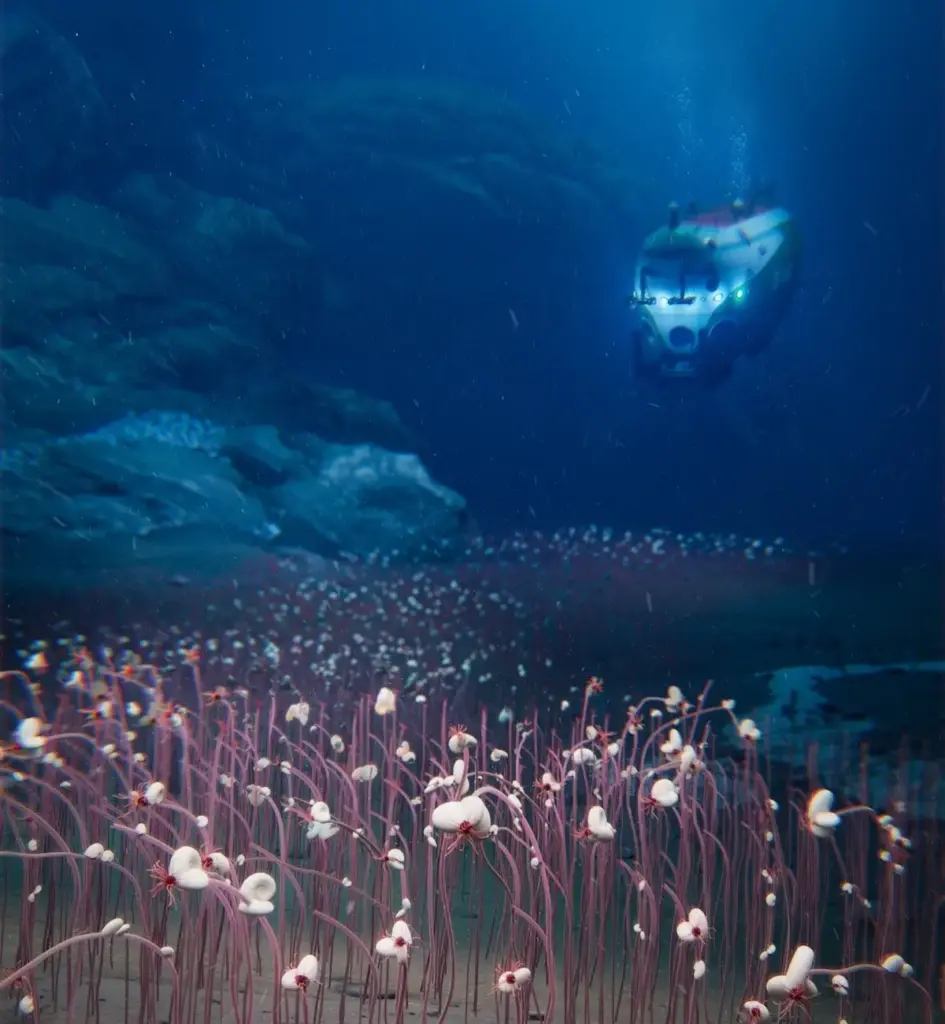
During a series of expeditions to the Kuril–Kamchatka Trench and the western Aleutian Trench, researchers utilized the manned submersible Fendouzhe to explore these hostile waters. Their subsequent dives into the western Pacific’s Mariana Trench—which plunges deeper than the height of Mount Everest—revealed a vibrant, unexpected ecosystem surviving in total darkness.
The newly discovered communities primarily consist of siboglinid polychaetes and bivalves. According to isotopic analysis, these organisms are sustained by hydrogen sulfide-rich and methane-rich fluids transported along faults traversing deep sediment layers in the trenches, where methane is produced microbially from deposited organic matter.
Because zero sunlight penetrates these extreme depths, the creatures cannot rely on photosynthesis for survival. Instead, they depend on chemosynthesis, a biological process that allows them to live off chemicals like methane seeping through cracks in the ocean floor. Video footage released alongside the study captured fields of tubeworms growing up to a foot long, alongside dense mounds of clams, free-floating marine worms, spiky crustaceans, sea lilies, and sea cucumbers.

Scientists involved in the project expressed astonishment at the sheer density and vitality of the ecosystem. Rather than finding isolated pockets of struggling organisms, researchers observed a thriving, complex community that resembles an oasis in the vast desert of the deep sea. The findings provide compelling evidence that microbes are actively producing methane at these extreme depths, with tubeworms observed clustering densely around snow-like microbial mats.
Lead author Xiatong Peng noted that given the geological similarities shared among various hadal trenches, these chemosynthesis-based communities might be far more widespread across the globe than previously anticipated. Co-author Mengran Du, a marine geochemist with the Institute of Deep-sea Science and Engineering at the Chinese Academy of Sciences, described the submersible descents as a surreal experience akin to traveling through time and unveiling a hidden world.
The Fendouzhe submersible completed 23 dives into the Mariana Trench last year alone. While the first explorers briefly reached the bottom of the crescent-shaped trench during a historic 1960 expedition, only a tiny fraction of humans have visited the site since. Among them was Hollywood director James Cameron, who completed a solo trip in 2012 and memorably described the environment as desolate and alien.
While earlier scientific expeditions had successfully identified single-cell organisms thriving on the seafloor, discovering larger animals in such quantities is a major milestone for marine biology. Previously, remotely operated vehicles had identified marine invertebrates, including tubeworms, living inside hydrothermal vents located 1.24 miles below the floor of the Pacific Ocean in Earth’s crust. The new study, however, pushes those boundaries miles deeper into the ocean’s most forbidding abyss.
The publication of these findings arrives at a critical juncture for global environmental policy, as international bodies debate the contentious issue of deep-sea mining for valuable minerals. Ocean scientists and conservationists have repeatedly warned that commercial mining operations on the largely unexplored ocean floor could permanently devastate fragile marine ecosystems in one of the last truly wild zones on Earth. Despite ongoing talks, the International Seabed Authority has yet to establish comprehensive rules governing the emerging industry.
As researchers continue to analyze the data and video footage collected by the Fendouzhe, the study—titled "Flourishing chemosynthetic life at the greatest depths of hadal trenches"—is already reshaping scientific models of deep-ocean carbon cycling. The discovery suggests that life is far more resilient and adaptable than previously understood, hinting that even more hidden ecosystems may be waiting to be discovered in the unexplored depths of the world’s oceans.