



As the gaming world edges closer to the long-awaited arrival of Grand Theft Auto 6, veteran reviewers are taking a comprehensive look back at each of the core installments in Rockstar Games’ legendary open-world franchise. While these retrospective pieces do not aim to issue traditional re-reviews or assign new numerical ratings, they serve a deeper purpose: re-examining the defining elements that made each game remarkable upon its initial release. Utilizing the franchise’s classic six-star wanted level as a loose ranking metric for long-term affection, the journey through the series ultimately arrives at its final, gargantuan stop: Grand Theft Auto V.
Thirteen years. Three separate console generations. Over 230 million copies sold. More than $10 billion in global revenue. The raw data outlining the longevity, cultural footprint, and commercial success of Grand Theft Auto V is not only wildly impressive, but virtually unprecedented in the history of entertainment media. Outside of absolute titans like Minecraft or the countless iterations of Tetris, very few interactive titles even enter the conversation.
Yet, numbers alone fail to explain why GTA V continues to move more copies every few months than most newly released games manage to sell over their entire lifespans. Statistics cannot capture why players remain perpetually captivated by its satirical vision of modern life, nor do they fully articulate what makes the experience uniquely special. To understand how the industry reached this milestone, one must look closely at the framework Rockstar built—starting, fittingly, with the climate and atmosphere.
A Striking Shift in Geography and Aesthetic
Where Grand Theft Auto IV’s Liberty City functioned as a dense, modestly sized, and entirely urban sandbox, GTA V’s rendition of Los Santos offered a world that was drastically more sprawling and visually varied. While the game retained a grid-like downtown core packed with towering corporate structures and imposing skyscrapers, Los Santos possessed an entirely distinct identity from its predecessor. Crucially, the map’s boundaries stretched far beyond the city limits into the vast expanse of Blaine County.
The aesthetic transition was remarkably stark. Depending on the shifting weather patterns, the unrelenting San Andreas sunshine gave vehicles a dazzling gleam, cast sharp architectural shadows, and saturated the entire landscape with a sun-bleached, West Coast atmosphere. Though it avoided the heavily stylized orange tint used to signify the oppressive, sweltering heat of 1992 Los Santos in Grand Theft Auto: San Andreas, the lighting was bright, effective, and a dramatic departure from the cold, drab, and gritty visual tone of Liberty City.
The environment was meticulously fractured into dozens of distinct districts that blended into one another with seamless continuity. Players could travel from the opulent, sweeping mansions of Vinewood Hills and Richman to the gaudy spectacle of Vinewood Boulevard—glowing under a thin layer of grime and entertainment industry sleaze. From the sun-kissed sands and aging beach-bum alleyways of Vespucci to the graffiti-tagged, economically struggling suburbs of South Los Santos, the geography felt lived-in and authentic.
Beyond the urban sprawl, the countryside opened up into desert wastes, dense forests, towering mountain ranges, and rural settlements dotted across the map. Effectively an expanded and modernized reimagining of the southern portion of the classic San Andreas map—encompassing Los Santos, Mount Chiliad, and the immediate surrounding wilderness—the environment was more than twice the size of the entire 2004 release. Even without featuring full-sized iterations of San Fierro or Las Venturas, the resulting world stood as a stunning technical achievement. Thirteen years after launch, players can still encounter background details, storefront signage, and architectural subtleties that manage to escape notice, proving that Rockstar’s dedication to environmental storytelling yields a world that remains endlessly fascinating.
Streiht Up Menace: The Three-Protagonist Innovation
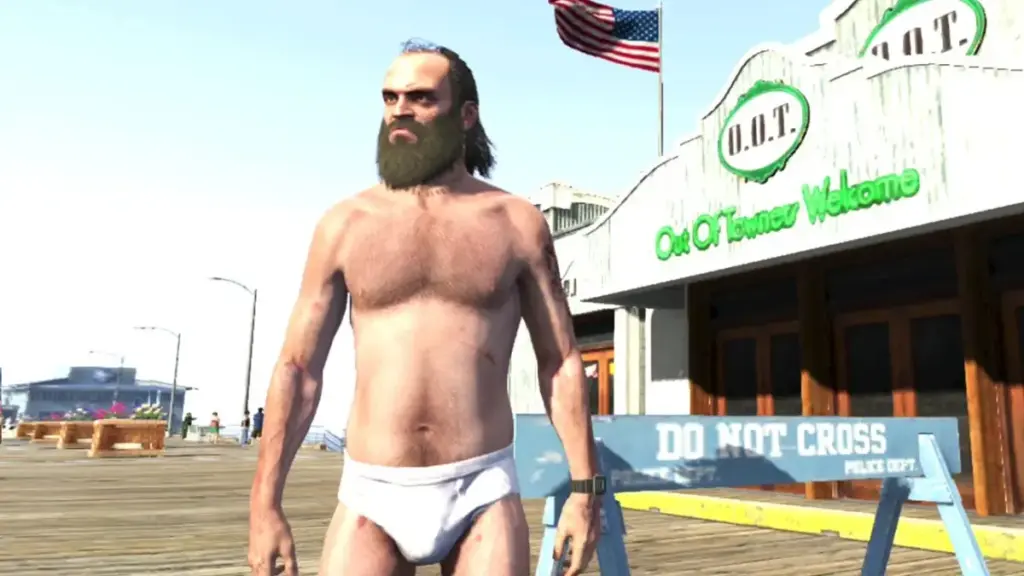
The most brilliant mechanism Rockstar devised to exploit this massive, densely detailed map was the implementation of its defining gameplay innovation: a trio of playable protagonists. Players could seamlessly switch between Michael De Santa, a retired bank robber growing increasingly frustrated with the quiet monotony of suburban family life; Franklin Clinton, an ambitious, low-level hustler looking for a major payday to pull him out of a decaying neighborhood; and Trevor Philips, a wildly volatile, psychotic criminal living in the desert fringes who shared a violent history with Michael.
This switching mechanic functioned as far more than a technical novelty. By dividing the narrative among three distinct viewpoints, Rockstar could organically guide players across different corners of the sprawling map without forcing a single protagonist to shoulder every narrative beat.

While Grand Theft Auto IV eventually experimented with multiple perspectives through its single-player expansions, The Lost and Damned and The Ballad of Gay Tony, those stories required players to pause the game and load separate packages. In GTA V, the transition between characters occurred in real time via a dynamic camera zoom that dropped the player straight into the middle of whatever activity that character happened to be engaged in at that exact second—whether cruising down a highway or harassing pedestrians. This clever design choice created the convincing illusion that these individuals continued to exist and navigate their lives independently outside of active missions.
Do It (‘Til You’re Satisfied)
The narrative structure was matched by a significant evolution in mission design. Building upon experimental checkpoints introduced in The Ballad of Gay Tony, GTA V permanently discarded one of the most persistent frustrations in open-world game design: the requirement to restart an entire mission from scratch upon failure.
With checkpoints acting as a reliable safety net, Rockstar felt empowered to craft longer, more cinematic, and mechanically ambitious set-pieces without risking player exhaustion. This design philosophy culminated in the game’s elaborate, multi-layered heists. Taking the foundational concepts of fan-favorite missions like GTA IV’s "Three Leaf Clover" bank robbery, the developers expanded them into the narrative and mechanical backbone of the entire campaign.
These marquee operations required meticulous planning, preparation, and the strategic deployment of Michael, Franklin, and Trevor, each bringing distinct skill sets to the execution. Furthermore, the inclusion of a robust mission-replay feature allowed players to experiment with different approaches to major scores without needing to restart the entire story from the beginning.
Higher Love and Combat Refinements
Alongside narrative and structural advancements, GTA V introduced substantial improvements to vehicle handling and third-person combat. Driving models were made significantly more approachable, featuring responsive steering and aggressive braking that favored nimble sports cars while maintaining a satisfying sense of weight. Furthermore, the vehicle roster returned to the diverse, expansive spectrum seen in San Andreas, allowing players to transition seamlessly from steering an eighteen-wheeler down a coastal highway to hijacking a military fighter jet.
Combat mechanics were similarly polished, boasting more fluid movement animations and a reliable, responsive cover-shooting system. Audio design during firefights received universal acclaim, with sharp weapon reports echoing realistically off urban surfaces. The integration of a weapon wheel—borrowed from contemporary titles like Red Dead Redemption and Max Payne 3—allowed players to carry an extensive arsenal within a single class without the risk of losing acquired hardware upon running out of ammunition or getting busted by law enforcement.
Party All The Time
When GTA V originally launched for the Xbox 360 and PlayStation 3 in September 2013, both hardware platforms were nearing the end of their respective lifecycles. Yet, rather than feeling constrained by aging technology, the title served as a stunning final statement for that console generation—and ultimately proved capable of spearheading the success of the hardware generations that followed.
Revisiting the title years later reinforces the staggering technical achievement it represented upon arrival. By extracting next-generation scope and ambition from hardware that debuted in 2005, Rockstar set a formidable benchmark for the open-world genre.
Ultimately, while subsequent entries and generational shifts continue to push the medium forward, Grand Theft Auto V stands as a masterclass in open-world design. Combining an extraordinarily detailed map, three compelling protagonists, diverse missions, and a foundation for enduring online play, it remains an undisputed peak for the storied franchise.