



Trails in the Accursed Mountains

The sound of cowbells clanging outside a bare-boned wooden cabin in Dobërdol, a high mountain settlement nestled at 5,700 feet in northern Albania, marks the start of another morning on the trail. Through a window slightly fogged by the chilly air, five chestnut-colored cows munch on grass just feet from the bedside, their bells and tails swinging away.
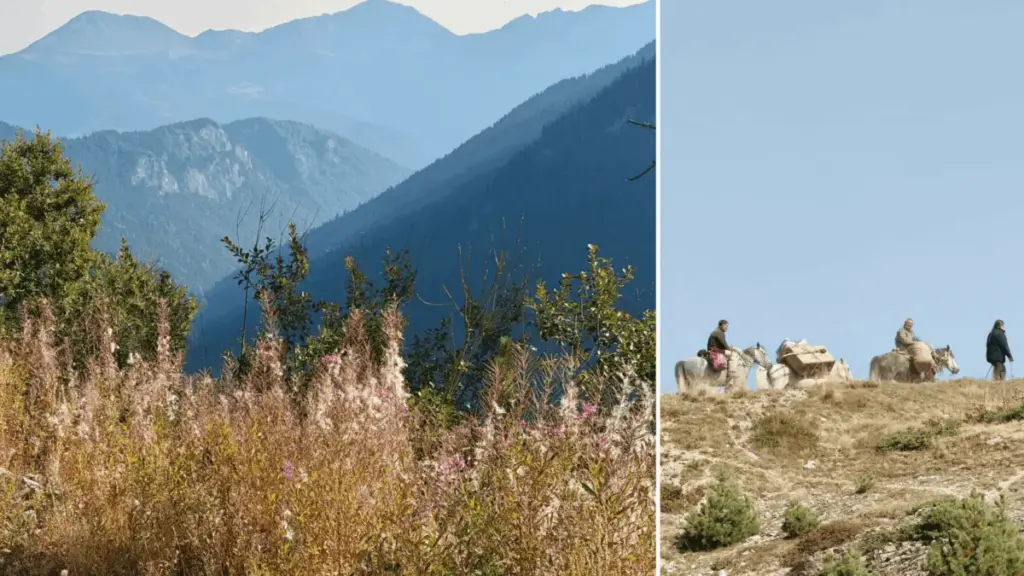
Stepping out into the crisp morning air requires navigating around a dozen or so hikers’ tents pitched across the guesthouse lawn. The previous day’s 10-mile trek from Çerem to Dobërdol remains fresh in the memory: dusty dirt trails edged with wild blueberries and patches of willow gentian, their petals an intense purple matching berry stains on the fingers. In these parts, pine, beech, and spruce forests grow thick enough to dim the daylight, and valleys fold inward with dizzying depth.

Mid-September brings an early start, with breakfast in full swing by 7 a.m. and not an empty seat left in the cozy, timber-framed dining room. The hosts, the Kurmekaj brothers, frantically shuttle plates loaded with fried eggs, sausage, fresh sheep cheese, and the ubiquitous Balkan cucumber-and-tomato salad.
This marks day four of a ten-day journey along the Peaks of the Balkans trek, a 119-mile inn-to-inn circular trail spanning the long-disputed borderlands of Albania, Kosovo, and Montenegro. The route winds through the Accursed Mountains—a range with an ominous name whose origins are variously attributed to the devil, war, or travelers cursing the unforgiving terrain. Conceived in the early 2010s as a cross-border peace and tourism project, the trail was designed to reconnect mountain communities splintered by conflict, create sustainable livelihoods, and give residents a reason to remain in or return to villages hollowed out by war and emigration.

By those measures, the initiative has achieved remarkable success. A late 2025 study published in the Journal of Outdoor Recreation and Tourism estimated that approximately 43,000 hikers now walk the trail annually, a steep rise from regional pre-pandemic estimates of roughly 20,000. This influx injects more than €25 million ($27.7 million USD) each year into mountain regions where family homes, shepherd settlements, and seasonal villages increasingly operate as guesthouses for trekkers. However, this success is also beginning to crowd some of the very communities the trail was established to support.
Ricardo Fahrig, representing the Albania-based adventure travel company Zbulo, which has operated trips on the trail since its early years, helped coordinate a self-guided route through the mountains. He notes that the contrast between busy Dobërdol and the quieter terrain found just beyond breakfast highlights a core issue facing the region. The challenge is not necessarily the overall volume of travelers, but rather their uneven distribution. While some sections remain sparsely visited, others, like Dobërdol, experience severe congestion during a relatively short operating season running from June through September, with some hikers pressing into early October.

Leaving Dobërdol, the morning congestion immediately dissolves. Other trekkers flow like a stream up the steep green lip of the expansive bowl-shaped valley toward Milishevc in Montenegro, the standard next stop.
Fewer travelers choose alternative, cattle-worn traces of the route. Among them is Stef Van Dam, a seasoned Dutch thru-hiker who detours off the official path toward the heart-shaped lake beneath Gjeravica, Kosovo’s highest peak—what he calls "the peak of the Peaks of the Balkans."

At an empty, wind-swept pass marking the Albania-Kosovo border, 1,600 feet of climbing later, hikers collapse onto rocks, resting in two countries at once. From this vantage point, the border is steeped in irony: a line so invisible that travelers must guess at its exact placement, yet one that has been fought over, fortified, closed, and redrawn for more than a century.
Ahead lies a narrow dirt track snaking through a treeless, boulder-strewn landscape on the Kosovo side. In the distance stands the village of Junik, where travelers plan to sleep, accompanied only by a golden eagle circling an unblemished autumn sky. For hikers seeking solitude far exceeding that of busier European paths like the Camino de Santiago, the remote stretches deliver precisely what they promise.

Further along the route, a scattering of rooftops resolves into summer homes and traditional katuns—seasonal shepherd settlements composed of simple huts and stone-walled livestock pens. At Guest House Tofaj, a three-story stone-and-wood building with a smoking chimney, nine-year-old Renaja welcomes visitors alongside three generations of women in the garden. Her mother and grandmother stand beside a plate of sugar cookies spelling out "wellcome," an extra letter met with a grin and a hand pressed to the heart, a universal sign of mountain gratitude.
The family has recently begun welcoming trekkers, radiating the excitement of hosts still delighted by every arrival. Downstairs, pizza bakes in an old wood-burning stove while the hosts set a long table for incoming guests. The highland tradition of besa—the belief that a house belongs not only to its owner, but to God and to the guest—comes to life. As Fahrig notes, invoking the Albanian expression bukë, kripë, zemër ("bread, salt, and heart"), the material offering may be simple, but the welcome remains unforgettable.

Continuing deeper into Kosovo and rejoining the main route, the trail alternates between empty mountain passes and stretches of asphalt. Fahrig estimates that locations like the Rugova Gorge—a river-carved passage featuring 2,000- to 3,000-foot-deep limestone walls, stone-blasted tunnels, and an emerald river—receive 30 percent or less of the traffic funneled through Dobërdol. Bypassing this region means missing a vital dimension of the journey.
In Drelaj, where the gorge opens into a wider pastoral valley, quiet highland hamlets are surrounded by forested mountains and chalet-like summer homes. A slender minaret rises at the center of the village. Blendi Lajqi, a local host at Konaku i Malsorit, explains that his family fled Drelaj during the 1998–1999 Kosovo War after Yugoslav and Serbian forces burned their home. For two decades, the abandoned property lay dormant. The creation of the trail provided his family and neighbors with a reason to return and rebuild.

The room now operating as a guesthouse apartment once served as a makeshift hospital for the Kosovo Liberation Army (UÇK), where Lajqi’s mother and aunt cared for the wounded. While many hikers arrive knowing little of this history, understanding the region’s past adds profound weight to the journey. The guesthouses serve a purpose far beyond mere hiking infrastructure, breathing new life back into land disrupted by conflict.
Tourism’s long-term transformation of the mountains is visible in Valbona, Albania, where Skender Selimaj of Hotel Rezidenca Quku i Valbones returned from the United Kingdom in the early 2000s. Operating initially without knowing if travelers would sustain it, Selimaj later helped clear passes toward Theth and Çerem and carried some of the first wooden trail signs into the mountains in 2009.

While the single-day hike over Valbona Pass to Theth has become one of Albania’s most popular routes, bringing economic benefits to local farmers and exposing children to global languages, it has also reduced the mountain solitude Selimaj once knew. Rather than wishing away tourism, he advocates for preserving a clean, green, and recognizably local landscape shielded from large-scale outside development.
For Fahrig, preserving living communities rather than tourist-centric enclaves requires spreading trekkers more evenly. This involves encouraging hikers to explore Kosovo, directing traffic toward quieter alternatives near busy passes, and guiding adventurous travelers toward newer routes like the 225-mile High Scardus Trail across North Macedonia, Kosovo, and Albania. In Kosovo, local guesthouse owners and tourism businesses are actively collaborating on volunteer efforts to carve natural alternative paths around paved sections without cutting villages out of the itinerary.

Completing the circuit and heading back toward Theth brings encounters with Cold War-era concrete bunkers built by communist dictator Enver Hoxha, signaling a return to Albania. Approaching Theth, hikers experience both versions of the Peaks: the bustling main paths and the quiet alternatives running alongside them.
On the final night at Bujtina Kometa in the quiet hamlet of Okol, a mezze spread prepared by host Ermira and her family gathers familiar faces around the table—fellow travelers whose paths have repeatedly crossed over ten days of trekking. With woodsmoke drifting from a neighbor distilling homemade raki, the busy tourist center of Theth feels worlds away. For one more night, the Accursed Mountains envelop visitors with their history, borders, and stories, proving that wide-open spaces and quiet persistence still endure in the heart of the Balkans.