


For a secret agent who prides himself on discretion and anonymity, James Bond manages to generate a remarkable and ceaseless amount of public discussion. Barely a day goes by without fresh speculation ricocheting across the media landscape regarding who will be the next actor to take on the iconic cinematic mantle of 007. As the long-running franchise looks toward its next chapter, current industry reports suggest that the exhaustive search has finally reached the crucial stage of final screen tests. Among the prominent names heavily linked to the coveted role are Callum Turner, Jack Lowden, and Josh O’Connor, each bringing their own distinct critical acclaim and British pedigree to the conversation.

Whoever ultimately steps forward to order their first shaken-not-stirred martini will join an extraordinarily exclusive fraternity. Since Sean Connery first introduced the British Secret Intelligence Service agent to global audiences in 1962’s Dr. No, only a handful of actors have officially defined the cinematic persona of James Bond. While millions know these men exclusively through the polished prism of high-speed car chases, tuxedo-clad galas, and exotic international espionage, their private lives off-screen present a starkly different and deeply human narrative. Archival photographs capturing these former 007 actors in their domestic spaces reveal the reality of the men behind the dinner jackets, offering a fascinating look at them settling into family life, pursuing quiet hobbies, and indulging personal interests that occasionally even followed them onto the silver screen.
Sean Connery: Before the Myth was Made

Long before he became synonymous with the effortless sophistication and lethal charm of Ian Fleming’s fictional spy, Sean Connery was simply an ambitious young actor trying to make his way in London. Photographed at his ground-floor basement flat in the NW5 postal district of England in 1955, Connery was still roughly seven years away from stepping onto a soundstage as James Bond. His surroundings during this period were notably modest, bearing very little resemblance to the hyper-luxurious, gadget-laden interiors and high-society penthouses his screen alter ego would soon frequent. In this quiet domestic setting, there was little outward suggestion of the monumental cultural phenomenon Connery was about to establish across six official films during the 1960s and early 1970s—a defining tenure that permanently anchored the character in cinematic history.
George Lazenby: A Brief and Accidental Spell in MI6

Securing the role of James Bond has never been an ordinary casting process, but George Lazenby’s path to MI6 remains one of the most unusual anecdotes in Hollywood history. According to the official Bond archives, landing the part required a heavy dose of strategic personal presentation and sheer coincidence on Lazenby’s part. The former model reportedly purchased an expensive, bespoke suit that had originally been made and left unclaimed by his predecessor, Sean Connery. Suited up in Connery’s aesthetic, Lazenby then visited Connery’s personal barber at the prestigious Dorchester hotel, specifically requesting the exact same haircut. In a twist of fate that reads like a Hollywood script itself, legendary producer Cubby Broccoli happened to be sitting in the neighboring barber chair.
Lazenby’s tenure as 007 was famously brief, restricted to a single, critically lauded appearance in the 1969 film On Her Majesty’s Secret Service. The production gave James Bond one of the most deeply personal and tragic storylines of the entire franchise, featuring Diana Rigg as his ill-fated bride, Tracy. By the time he was photographed at his home in Kensington, London, in February 1973, Lazenby had already walked away from the role, choosing to step down before the film was even released. Seated with official papers in hand, the archival image captures him surrounded by a dense collection of books, vinyl records, and a guitar propped casually beside the sofa. A glass-topped coffee table sits crowded with eclectic objects, including a striking decorative horse’s head, while a substantial wooden cabinet provides heavy storage in the background. Later that same year, Roger Moore officially took over the franchise, making his 007 debut in Live and Let Die.

Roger Moore: From Reading the Dictionary to Thrilling Scripts
Long before he was pouring martinis on-screen as the longest-serving cinematic James Bond, Roger Moore was simply a hardworking television actor navigating the British and American entertainment industries. In a charming archival photograph dating back to circa 1955 at his home in Los Angeles, a youthful Moore is captured sitting comfortably while intently reading a dictionary—a modest domestic snapshot far removed from the high-stakes thrills of international espionage.

Moore’s personal life during these formative years was deeply rooted in the British home counties. He married his second wife, the celebrated Welsh singer Dorothy Squires, in 1953. The couple lived primarily at a grand property known as The Mount, a substantial mansion situated on Wansunt Road in Old Bexley, Kent. Archival images from the era capture the couple sharing domestic moments, including a photograph outside their Kent home in 1957, followed by another relaxed portrait in 1958. However, the marriage eventually dissolved, leading to a divorce in 1968.
A year later, Moore married Luisa Mattioli, and the couple established their base at Sherwood House in Denham, Buckinghamshire. Located conveniently close to Pinewood Studios—the historic home of the Bond franchise—the property served as their primary family residence during Moore’s first three outings as 007. In his autobiography, Moore fondly described the property as being wonderfully near London and ideal for a growing family. The estate’s considerable appeal extended far beyond its interior walls, boasting expansive grounds that included extensive gardens, a tennis court, a heated swimming pool, and traditional greenhouses when the historic property eventually went on the market for £5 million in 2015.

Timothy Dalton: Licensed to Bloom
When Timothy Dalton finally accepted the mantle of James Bond in the mid-1980s, he approached the iconic character with a level of theatrical seriousness and literary dedication that set him apart. Interestingly, the film producers had actually considered Dalton for the role much earlier in his career, but the classically trained Welsh actor felt he was simply too young to properly embody the world-weary intelligence agent. When he eventually signed on to star in The Living Daylights in 1986, Dalton took a scholarly approach to the preparation. Rather than relying solely on the cinematic tropes established by his predecessors, he thoroughly reread Ian Fleming’s original novels to craft a grittier, more faithful, and psychologically complex interpretation of the character.

Pierce Brosnan: Domestic Tranquility Before GoldenEye
Before his face became synonymous with the sleek, high-tech era of 1990s blockbusters, Pierce Brosnan was steadily building his American television career starring in the hit series Remington Steele. However, his eventual introduction to the inner circle of the Bond franchise came quite naturally through his first wife, the talented Australian actress Cassandra Harris. Harris had secured a role in the 1981 Bond film For Your Eyes Only, and visiting her on location in Corfu brought Brosnan directly into the social and professional orbit of the film’s producers. Recognizing his suave charm, Broccoli and his team informally offered Brosnan the role of 007 in 1986. Unfortunately, lingering contractual obligations to his television network prevented him from accepting the part at that exact moment, delaying his official debut as agent 007 in GoldenEye until nearly a decade later, in 1995.

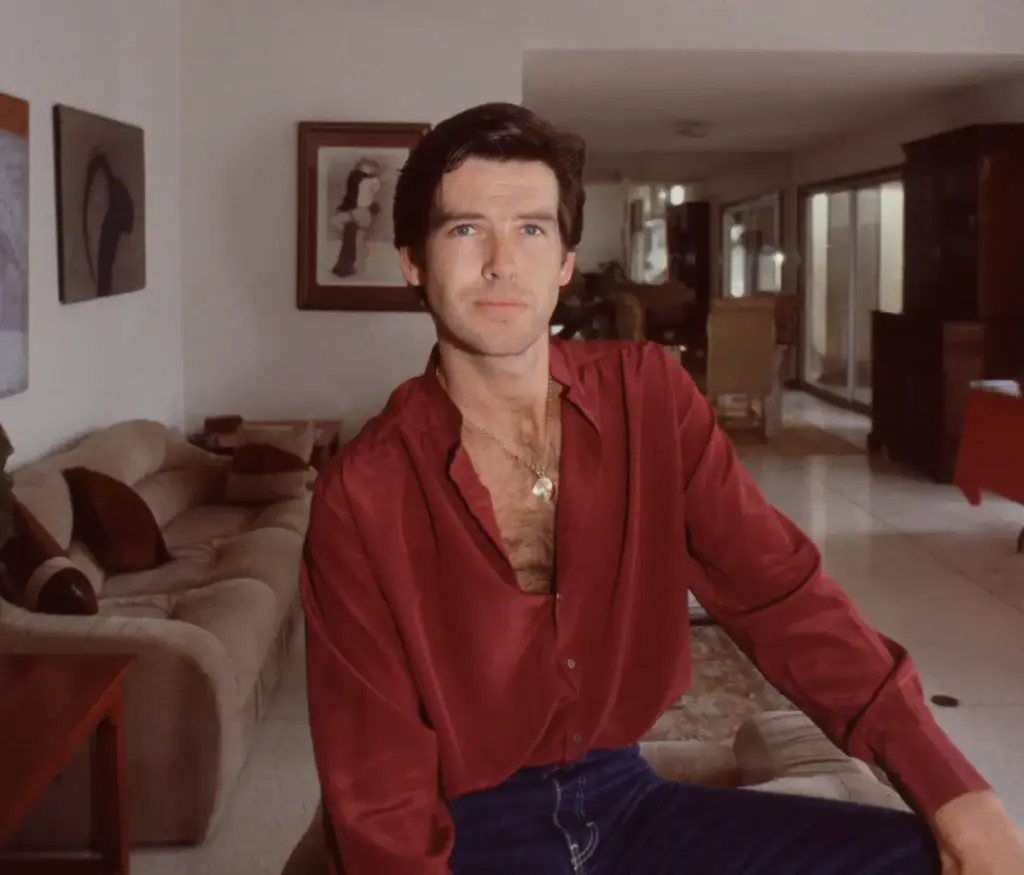
A series of intimate photographs taken at his Los Angeles home in 1992 capture Brosnan during a deeply transitional period in his life. The images show him playing the guitar on the living room sofa, enthusiastically shooting pool with his eight-year-old son Sean, and entertaining two energetic dogs out on the sunlit lawn. The interior is decorated with cream-colored sofas and soft floral upholstery, while elegant arched windows and white shutters throw open the airy living space to the lush surrounding greenery. Taken just one year after Harris tragically passed away from ovarian cancer at the age of 43, these photographs offer a poignant look at a devoted father single-handedly raising his family in the quiet years before the monumental success of Bond permanently transformed his career trajectory.
During the difficult period of his wife’s illness, painting had quietly re-emerged as an essential creative outlet and emotional refuge for Brosnan. Having originally trained as a commercial artist in London before turning his focus entirely to acting, he returned to the canvas in the late 1980s. Reflecting on this therapeutic return to the arts on his official website, Brosnan noted that he started painting again and every color imaginable poured out onto the canvas. By the time he officially stepped into the tuxedo for GoldenEye, painting had become so deeply embedded in his daily routine that his private dressing room at Leavesden Studios doubled as a working art studio during production.

Daniel Craig: Domestic Intelligence, Classified
For the final entry in this historical survey of 007 residences, the front door remains firmly and deliberately closed. Among all the actors who have ever worn the iconic heavy wool suits of James Bond, Daniel Craig represents a definitively modern and strictly guarded approach to sharing the realities of domestic life with the public. Throughout his historic five-film tenure—which culminated with No Time to Die—Craig and his wife, acclaimed actress Rachel Weisz, maintained an intentionally private existence away from the relentless glare of celebrity culture.

Weisz articulated the couple’s shared philosophy regarding privacy during a candid 2012 interview with British Vogue, stating that she considers it entirely ordinary and healthy to believe that a marriage should remain strictly private and sacred. Even years after hanging up his holster and passing on the fictional agency’s keys, ongoing public speculation regarding who will ultimately inherit Craig’s legendary martini glass ensures that his name remains firmly entrenched in headlines, bridging the gap between the franchise’s storied past and its highly anticipated future.