



Fresh dog food has expanded rapidly across the pet care market, offering dog owners high-quality alternatives to traditional dry kibble and canned foods. Today, fresh pet nutrition is broadly divided into two primary storage formats: refrigerated and frozen. While both categories represent gently cooked, real-food nutrition, they behave very differently once brought into a home kitchen.
Refrigerated fresh food is purchased chilled and stands ready to serve straight out of the refrigerator, whereas frozen fresh dog food is gently cooked at the production facility, frozen to preserve freshness, and requires thawing in the refrigerator prior to feeding. The central distinction between the two options does not boil down to nutritional quality or basic freshness, but rather to shelf life, kitchen planning, packaging routines, and how effectively each format prevents food waste.
Understanding the practical differences between refrigerated and frozen options allows pet parents to select the product that best aligns with their dog’s dietary requirements, their household’s cold-storage capacity, and their daily schedule.
Refrigerated vs. Frozen Fresh Dog Food: The Short Answer
When evaluating refrigerated versus frozen fresh dog food, neither format holds an inherent monopoly on safety or nutritional value. Both options consist of real, cooked food formulated to support canine health, provided they are stored and handled according to manufacturer instructions. The decision primarily comes down to a trade-off between immediate convenience at the food bowl and long-term storage flexibility in the kitchen.
Refrigerated fresh dog food offers the ultimate immediate convenience. Because it remains chilled without ever being solid-frozen, pet owners can open the package and serve it instantly without advance planning. However, this convenience comes with a trade-off: refrigerated food features a significantly shorter total shelf life and a strict opened-life window, typically requiring use within five to seven days after unsealing.
Conversely, frozen fresh dog food excels in longevity and waste reduction. Because the food is frozen immediately after gentle cooking, it locks in peak freshness and can remain stored in a home freezer for extended periods until needed. The trade-off in this case is the necessity for advance planning, as frozen packages must be transferred to the refrigerator to thaw prior to mealtime.
Selecting the ideal format requires balancing several key factors:
- Storage Location: Refrigerated options occupy daily refrigerator shelf space from day one, while frozen options reside in the freezer until moved to the fridge for thawing.
- Opened Shelf Life: Refrigerated rolls typically must be consumed within a week of opening. Frozen options, such as Get Real by Chewy, should generally be consumed within three to five days once fully thawed in the refrigerator.
- Thawing Requirements: Refrigerated food requires zero thaw time and is ready to serve immediately. Frozen food requires planning ahead—taking anywhere from 12 to 24 hours for smaller 5-ounce and 12-ounce packs, or 35 to 48 hours for larger 24-ounce packs to thaw safely in the fridge.
- Portioning Mechanics: Refrigerated options are often packaged in large rolls or multi-serve bags that require slicing or scooping. Frozen foods are frequently packaged in pre-portioned, sealed units tailored to daily meal sizes.
- Best Household Fit: Refrigerated formats suit owners who prioritize instant serving without scheduling thaws. Frozen formats suit households seeking extended storage capacity, reduced food spoilage, and simple portion control.
Ultimately, household logistics dictate the ideal choice. A family caring for a large-breed dog with limited freezer space may lean toward refrigerated rolls, while a small-dog owner looking to minimize spoiled leftovers may find frozen pre-portioned packs far more economical and practical.
What Frozen Fresh Dog Food Is
Frozen fresh dog food refers to complete and balanced canine diets that are gently cooked to preserve nutrients and eliminate pathogens, then rapidly frozen to lock in quality without relying on artificial chemical preservatives. Freezing acts as a natural preservation method, holding the food at peak quality without altering its underlying nutrient profile. When stored properly in a home freezer, the food remains preserved until it is moved into the refrigerator to thaw prior to serving.
It is important for consumers to distinguish cooked frozen dog food from other frozen or alternative pet food formats on the market:
- Cooked Frozen Food: Gently cooked prior to freezing; requires only thawing before serving.
- Raw Frozen Food: Uncooked meat and ingredient formulations frozen raw; requires strict bio-handling precautions and thawing.
- Freeze-Dried Food: Moisture is extracted through low-temperature vacuum drying, making the food shelf-stable at room temperature until rehydrated.
- Frozen Patties: Frequently contain raw formulations, though some cooked variations exist; verifying the product label is essential.
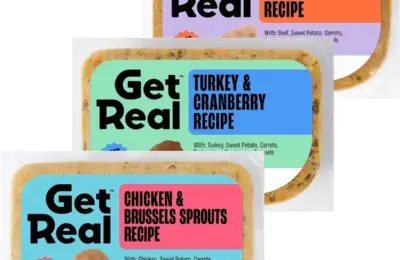
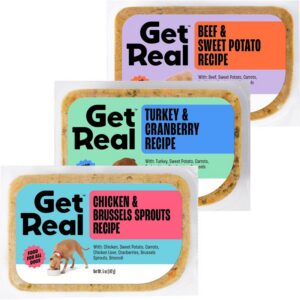
A primary example of the gently cooked frozen category is Get Real, Chewy’s proprietary fresh dog food line. Formulated with human-grade ingredients, Get Real recipes contain ten primary ingredients or fewer, supplemented with essential vitamins and minerals. The meals are gently cooked, frozen into individual packages, and formulated to meet the nutrient profiles established by the Association of American Feed Control Officials (AAFCO) for all life stages, including the growth of large-size dogs weighing 70 pounds or more as an adult.
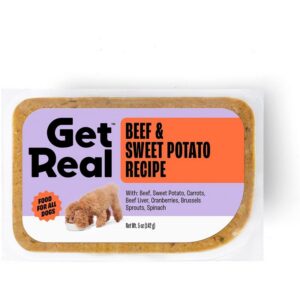
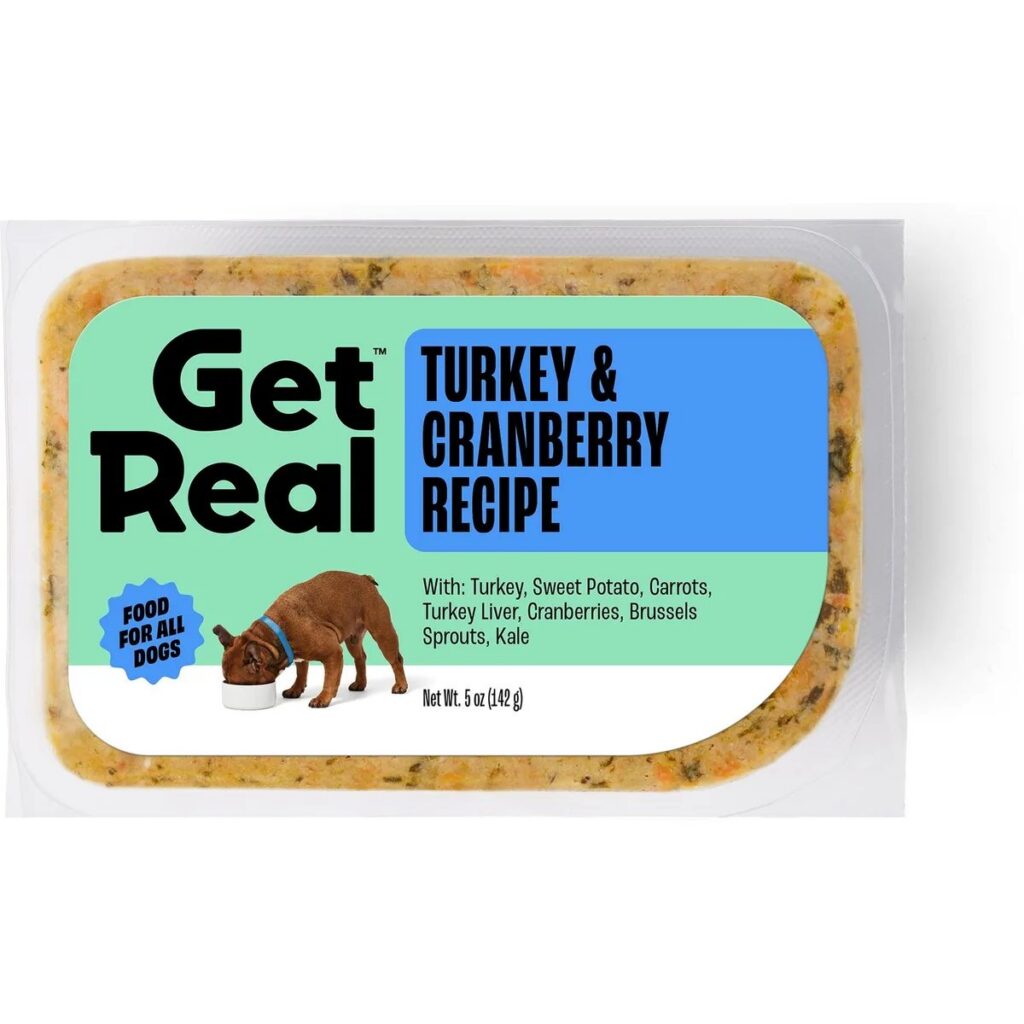
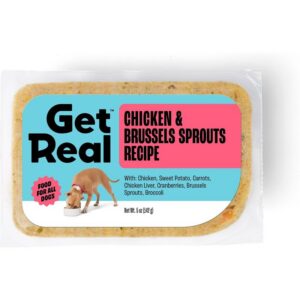
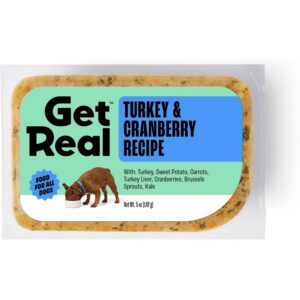
Get Real offers three distinct protein recipes: Chicken & Brussels Sprouts, Beef & Sweet Potato, and Turkey & Cranberry. For instance, the Get Real Beef & Sweet Potato Recipe lists real beef as the primary ingredient, followed by sweet potato, carrots, and beef liver. To help dog owners introduce the format into their routine, a sampler pack bundle is available containing two packs of each recipe, allowing dogs to try different flavors while owners evaluate the freezer-to-fridge thaw schedule. Get Real is sold exclusively online through Chewy in select markets and is shipped directly to doorsteps in insulated packaging packed with dry ice to maintain the cold chain during transit.
What Refrigerated Fresh Dog Food Is
Refrigerated fresh dog food is cooked, packaged, and maintained under continuous refrigeration from the manufacturing plant through transport, retail display, and home storage. Prominently displayed in refrigerated coolers at grocery stores and specialty pet retailers, this format is usually packaged in tightly wrapped chub rolls or resealable multi-serving bags.
Freshpet represents the most widely recognized brand in the refrigerated pet food space, and its official product guidelines serve as an industry benchmark for handling chilled pet diets. According to published feeding and storage guidance from Freshpet, opened refrigerated rolls should be fully consumed within 7 days, while opened bags should be finished within 5 to 7 days depending on the specific product line.
Because refrigerated pet food carries a fixed post-opening clock, managing portion sizes is critical. If a pet owner purchases a large roll that their dog cannot finish within the recommended 5 to 7-day window, the remaining portion risks spoilage unless frozen. Freshpet notes that owners can freeze leftover portions if necessary, recommending that the food be divided into single-meal portions stored in airtight containers and thawed in the refrigerator overnight when ready to use.
The essential operational factor for refrigerated food is strict adherence to this opened-life window. If a product roll is too large for a small dog’s daily caloric requirement, the owner must manually slice, portion, and freeze the excess to prevent unnecessary food waste.
Shelf Life and Food Safety Guidelines
Both refrigerated and frozen fresh dog foods are entirely safe and wholesome when handled properly, but both can deteriorate if temperature controls are compromised. Maintaining food safety relies strictly on controlling temperature and managing time.
The U.S. Food and Drug Administration (FDA) provides clear safety guidelines for handling fresh pet foods:
- Maintain home refrigerator temperatures at or below 40°F (4°C).
- Refrigerate or discard leftover fresh pet food promptly after serving.
- Wash hands, feeding bowls, utensils, and measuring scoops thoroughly with soap and warm water after every use.
- Never leave fresh pet food sitting at room temperature for longer than two hours.
Frozen fresh food provides a considerably longer overall shelf life prior to opening because low freezer temperatures halt microbial growth. Packages of frozen food, such as Get Real, go directly into the freezer upon arrival. Once transferred to the refrigerator to thaw, the food should be consumed within three to five days. If thawed food remains held continuously at or below 40°F, it may be refrozen if necessary, though discarding any food that exhibits off-odors, discoloration, or has exceeded room temperature thresholds remains a mandatory safety rule.
Refrigerated food, by contrast, begins its consumption countdown immediately upon being unsealed in the kitchen. Owners must track opening dates carefully to ensure the food is fully used within the manufacturer’s specified timeframe.
Delivery and transport logistics introduce another crucial element to the cold chain. Online orders of frozen food like Get Real arrive in insulated shipping boxes packed with dry ice, designed to remain frozen for up to 8 hours after doorstep delivery depending on environmental temperatures. Owners should unpack deliveries and place frozen packs into the freezer immediately upon retrieval. Similarly, store-bought refrigerated food should be picked up at the end of a shopping trip and refrigerated promptly upon returning home.
Processing, Preservatives, and Ingredient Profiles
Because fresh pet foods rely on cold temperatures rather than heavy processing or intense chemical preservation, their ingredient decks are typically concise and focused on whole foods. High-heat canning and dry kibble extrusion demand high thermal processing and moisture reduction to achieve long shelf stability at room temperature; fresh formats use gentle cooking combined with refrigeration or freezing to maintain stability.
Freezing serves as an effective physical preservation method on its own. Because extreme cold prevents bacterial multiplication and delays fat degradation, frozen recipes require minimal additive preservatives. Get Real recipes, for example, stick to simple recipes containing 10 main ingredients or fewer alongside vital vitamin and mineral premixes. On product labels such as Get Real’s Beef & Sweet Potato Recipe, mixed tocopherols—a natural form of Vitamin E—are included within the nutrient blend to protect dietary fats from oxidation over time.
When evaluating ingredient panels across both frozen and refrigerated fresh options, pet owners should look beyond the cold-storage method and focus on core nutritional metrics:
- Complete and Balanced Claims: Verify that the package carries an official AAFCO statement confirming the diet provides complete and balanced nutrition for your dog’s specific life stage (e.g., adult maintenance or all life stages including large-breed growth).
- Whole Protein Sources: Ensure named animal proteins (such as real beef, chicken, or turkey) lead the ingredient list, supplemented by nutrient-dense organ meats like liver.
- Caloric Density Transparency: Confirm clear caloric reporting on the packaging to facilitate accurate portion control. For example, Get Real explicitly lists caloric contents on its packaging: 428 kcal per 12-ounce pack for Chicken & Brussels Sprouts, 451 kcal per 12-ounce pack for Beef & Sweet Potato, and 474 kcal per 12-ounce pack for Turkey & Cranberry.
Convenience: Storage Space, Thawing Schedules, and Portioning
Daily convenience varies significantly between refrigerated and frozen formats, depending on how a household manages kitchen workflow, storage capacity, and meal preparation.
Refrigerated fresh food delivers immediate convenience directly at the food bowl. With no thawing phase required, pet parents simply retrieve the roll or bag from the fridge, slice or measure the desired portion, and serve. The primary operational trade-off is refrigerator real estate—storing multi-pound rolls or large bags consumes space on refrigerator shelves that would otherwise be used for human groceries.
Frozen fresh food shifts the convenience advantage toward long-term kitchen management and portion precision, while introducing a mandatory thaw schedule. Frozen packs require dedicated freezer space, meaning pet owners should measure their freezer capacity before ordering bulk shipments.
Thawing frozen packs requires advance routine planning:
- 5-ounce and 12-ounce packs: Require 12 to 24 hours to thaw safely in the refrigerator.
- 24-ounce packs: Require 35 to 48 hours to thaw completely in the refrigerator.
For most dog owners using frozen food, establishing a seamless routine involves placing tomorrow’s pack into the refrigerator each evening while retrieving today’s thawed pack for feeding. Once established, this rotation takes only seconds a day.
Portion control is another distinct operational difference. Slicing refrigerated rolls manually can lead to inconsistent portion sizes and caloric variability over time. Pre-portioned frozen packs eliminate guesswork by providing calibrated unit sizes. Get Real offers several distinct pack sizes to accommodate different feeding strategies, including 5-ounce mixer packs designed for use as meal toppers alongside dry food, as well as 12-ounce and 24-ounce packs designed for full daily meals.

What Affects Value: Portions, Waste Reduction, and Delivery
Evaluating the true financial value of fresh dog food requires looking beyond the initial purchase price or retail cost per pound. The true cost per bowl is heavily governed by portion precision and food spoilage rates.
Refrigerated food can lead to unexpected food waste if the package size exceeds what a dog can safely consume within the 5 to 7-day post-opening window. If a small dog consumes only a fraction of a large refrigerated chub before it reaches its expiration deadline, the remaining spoiled food represents lost value unless the owner consistently spends extra time slicing and freezing individual portions ahead of time.
Frozen fresh food inherently mitigates waste through controlled batch thawing. Because unopened packs remain safely stored in the freezer for months, owners only unfreeze the precise amount of food their dog will consume over the next few days. This makes pre-portioned frozen formats highly cost-effective for small-breed owners, multi-dog homes managing mixed diets, or pet parents using fresh food exclusively as a high-value topper on kibble.
Additionally, fulfillment methods impact overall value. Direct-to-door delivery models for frozen foods eliminate routine store trips and ensure a steady inventory, provided the household has adequate freezer space to accommodate multi-week shipments.
Which Format Fits Your Dog and Routine?
Selecting between refrigerated and frozen fresh dog food ultimately depends on matching product specifications to your dog’s size, your kitchen layout, and your personal daily routine.
Consider choosing Refrigerated Fresh Dog Food if:
- You prefer to serve food immediately without managing a advance thaw schedule.
- You have ample, dedicated shelf space inside your main kitchen refrigerator.
- You care for medium-to-large dogs that rapidly consume entire rolls or bags within 5 days, minimizing the risk of spoilage.
- You prefer purchasing pet food during weekly physical grocery or pet store visits.
Consider choosing Frozen Fresh Dog Food if:
- You want extended storage life and prefer stocking up on pet food less frequently.
- You have accessible freezer space to store multi-pack boxes.
- You care for a small dog or plan to use fresh food as a meal topper, where spoiling open multi-serve packages is a primary concern.
- You want pre-measured, pre-portioned packs that simplify caloric tracking and standard meal preparation.
- You prefer direct-to-door home delivery schedules.
For pet parents who determine that frozen fresh food fits their home management style, lines like Get Real by Chewy provide practical variety. Offering chicken, beef, and turkey options in uniform package sizes allows owners to rotate protein sources easily without disrupting their established freezer-to-fridge thawing system.
Frequently Asked Questions: Refrigerated vs. Frozen Dog Food
Can dogs eat food that is still raw or frozen solid?
It is strongly recommended to thaw fresh food completely in the refrigerator before serving. Offering food frozen solid can be tough on a dog’s teeth, increases the risk of gulping large unchewed chunks, and makes digestion more difficult. Additionally, raw frozen foods carry inherent bacterial risks that require proper handling and thorough thawing in the fridge. Gently cooked frozen foods should also be fully thawed before mealtime, though small frozen bites are occasionally used as deliberate enrichment treats.
Should all fresh dog food be stored in the refrigerator?
Refrigerated fresh food must remain chilled at all times prior to use, and open packages of canned or frozen fresh food must be kept in the fridge once opened or thawed. The FDA recommends holding all opened or perishable pet foods at or below 40°F. Unopened dry kibble does not require refrigeration and should be kept sealed in its original packaging in a cool, dry environment.
Is non-frozen refrigerated fresh dog food inherently better than frozen food?
No. Refrigerated fresh food offers immediate serving convenience, but carries a much shorter post-opening shelf life. Frozen fresh food undergoes the exact same gentle cooking process and nutritional formulation; freezing simply acts as a natural physical preservation step to extend shelf life. Neither option is inherently superior in quality; the ideal choice is the format that fits your storage capacity and prevents food waste.
Are frozen dog food patties considered a complete and balanced meal?
Only if the package explicitly displays an AAFCO complete and balanced statement. Many frozen patties or raw chubs sold in the pet market are formulated strictly for supplemental feeding or mixing. Always check the label to ensure the product is certified as a complete diet for your dog’s specific life stage.
What key features should owners look for when comparing frozen dog food brands?
Look for clear processing disclosures (whether the food is gently cooked or raw), an official AAFCO complete and balanced statement, transparent calorie counts per package, high-quality named animal proteins, simple whole-food ingredient lists, and pre-portioned packaging sizes that match your dog’s daily caloric needs. Clear, detailed handling and thawing instructions on the packaging are also strong indicators of a manufacturer’s commitment to safety standards.