
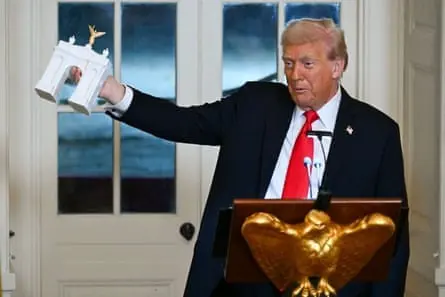
A federal judge has issued a temporary restraining order halting construction work on Donald Trump’s towering triumphal arch for 14 days, delivering a major legal setback to one of the president’s most prominent and ambitious projects aimed at reshaping the physical landscape of the nation’s capital.
The temporary restraining order was handed down by US District Judge Tanya Chutkan in the early hours of Friday morning. The judicial intervention followed a flurry of fast-tracked government actions on Thursday, which included the final approval of the massive 250-foot-high—or 76-meter—arch by the National Capital Planning Commission. That approval was secured through an 8-4 vote following a marathon, nine-hour public hearing where scores of witnesses voiced vehement opposition to the construction plans.
The proposed monument represents just one of several contentious projects undertaken by Donald Trump around Washington as part of a broader vision to remake the city. His administration’s urban design initiatives have ranged from renovating storied public golf courses to threatening the demolition of the John F. Kennedy Center for the Performing Arts. However, these sweeping federal projects could soon encounter significantly greater legislative scrutiny now that Democrats have gained control of Congress.
Prior to Judge Chutkan’s ruling, the administration had signaled that work on the arch could commence almost immediately following the planning commission’s green light. This momentum depended on the Department of the Interior issuing a final decision authorizing construction, followed by the mandatory publication of proper notification by the National Park Service.
In issuing the 14-day delay, Judge Chutkan granted the urgent request put forward by the latest plaintiffs participating in the multi-pronged legal challenges aiming to block the arch. Alongside this temporary halt, Judge Chutkan consolidated several existing lawsuits. These included actions brought forward by the District of Columbia and the state of Virginia, combined with a separate legal challenge filed by a group of Vietnam veterans and an architectural historian who argue the monument violates federal planning and commemorative laws.
Financial details surrounding the monument remain murky. It is still unclear precisely how much the project will ultimately cost taxpayers or how its construction will be funded, though independent estimates for the towering structure have reached as high as $100 million.
The high-stakes vote by the National Capital Planning Commission on Thursday capped off nine and a half hours of intense testimony from scores of individuals opposing the design. The final tally broke starkly along federal and local lines. Commissioners who voted in favor of the arch were either political appointees working directly for the administration or individuals closely connected to the president, who had been pushing aggressively for immediate construction. Conversely, the dissenting votes were cast by commissioners representing the local interests of the city of Washington.
The remote, call-in hearing itself was fraught with technical difficulties, crashing repeatedly during the first few hours and accompanied by a virtually unanimous stream of negative public comments. The session drew witnesses who offered impassioned testimony opposing a structure they argued would fundamentally destroy the solemnity and historical character of the nearby Arlington National Cemetery, where hundreds of thousands of fallen service members and military veterans are interred.

Despite the heavy public pushback, the panel’s Trump-appointed chair launched the meeting with a glowing appraisal of the towering monument, explicitly praising the president for conceiving the idea.
“President Trump understands as president and a superb builder that it’s important to our national identity to display who we are through grand monuments,” said Mark Paoletta, the commission’s chair, who also serves as general counsel for the White House Office of Management and Budget.
Echoing arguments frequently voiced by the president, Paoletta added, “As Trump has often remarked, the great cities around the world have arches: Paris, Rome, London.”
Other administration defenders on the panel similarly framed the monument as a tribute to national service rather than a political statement. Commissioner Paul Ingrassia, a lawyer representing the General Services Administration, argued that the arch was “not about politics. It’s about remembrance. It’s about celebrating our history. It’s about commemorating veterans. And it’s really something that’s a noble tribute to our nation and something that we can all rally behind.”
Local officials and congressional critics, however, sharply disputed those characterizations during the hearing. DC city council member Phil Mendelson, who also sits on the planning panel, pointed out that the project had failed to secure the necessary statutory approval from Congress, nor had lawmakers appropriated any funds for its realization. Mendelson noted that the formal plan submitted to the commission omitted any reference to the military use frequently cited by Trump and other administration officials to justify the monument.
“We cannot approve final site and building plans until we have the final site and building plans,” Mendelson stated during the proceedings.
That sentiment was echoed on Capitol Hill by Representative Jared Huffman, a California Democrat who is slated to chair the House Natural Resources Committee. Huffman sharply criticized the venture during his testimony to the commission, labeling the project both ill-advised and illegal.
“This arch would dishonor America,” Huffman told the commission. He characterized the proposed structure as “a tribute to Donald Trump” rather than a genuine monument to veterans, directly challenging the rationale put forward by Trump administration officials. Huffman argued that the monument closely mirrors structures traditionally built to honor
emperors or kings, asserting that the president was utilizing veterans merely as a political pretext to construct a grandiose memorial to himself.