




Published September 22, 2026, by Ellyn Kail
The long-awaited grand opening of the newly renovated Belmont Park was supposed to herald a bright, modernized era for New York horse racing. Instead, the multi-million-dollar debut weekend was quickly overshadowed by tragedy. During a sprint race on opening weekend at the lavish $550-million facility, a Thoroughbred mare named Heat Missile suffered a catastrophic breakdown on the track, sustaining severe injuries that brought an abrupt and violent end to her life.
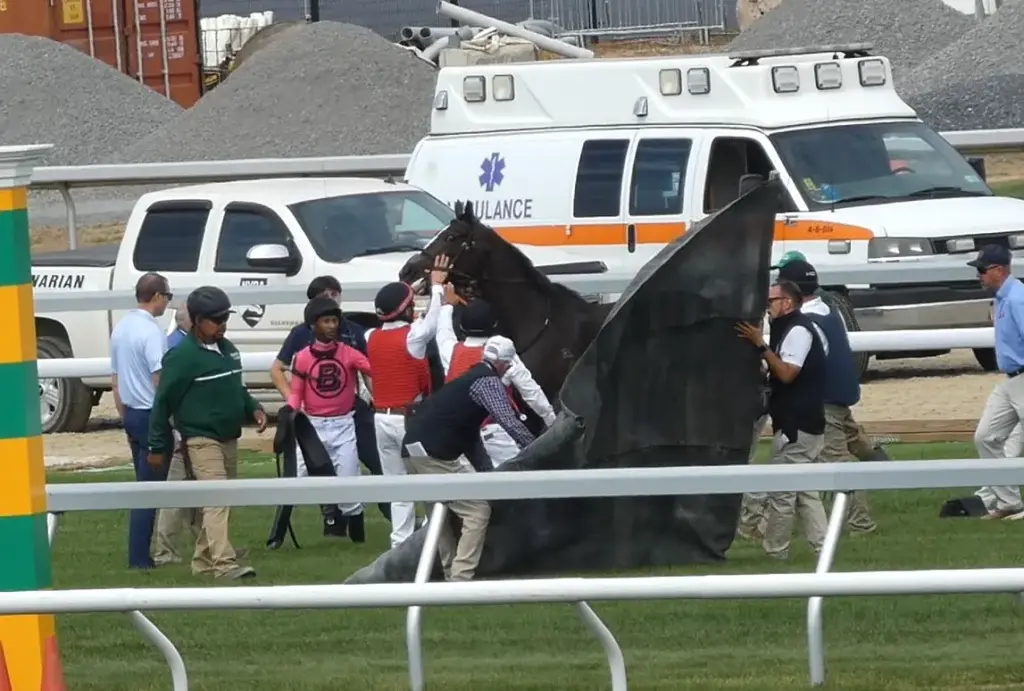
According to eyewitness accounts and exclusive footage captured at the scene, Heat Missile suffered devastating injuries to her left front leg. Both sesamoid bones were fractured, and her fetlock joint completely dislocated during the sprint. Track workers rushed to her side, desperately cradling her mangled leg as a veterinarian prepared a syringe filled with a euthanasia drug.
Before the lethal injection could be administered, the mare turned with wide, panicked eyes. Quick-thinking workers erected a privacy screen around her to block the grim scene from the view of spectators in the grandstand, and they covered her eyes to calm her. Moments later, the horse—who had entered the race as the betting favorite—was dead.
The incident occurred on Saturday, September 19, marking only the second day of live racing at the newly rebuilt Belmont Park. The massive redevelopment project was financed in part by a staggering $455 million taxpayer-funded loan from the State of New York. Combined with other funding streams, the New York Racing Association (NYRA) poured a total of $550 million into upgrading the historic grounds into a state-of-the-art racing venue. Yet, despite the state-of-the-art infrastructure and millions of dollars spent on modernizations, the facility failed to ensure the safety of the animals competing on its track, losing a horse before the opening weekend festivities had even concluded.
Following the removal of Heat Missile’s body from the racing surface, the day’s events continued unabated. Spectators kept cheering, bettors continued placing wagers, and the opening weekend celebrations pressed forward as though nothing extraordinary had occurred.
However, the tragedy at Belmont Park was not an isolated incident. Hundreds of miles away at Churchill Downs in Kentucky—another legendary home of American horse racing—catastrophe struck another young animal on the very same day.
Lutkenhaus, a two-year-old horse, suffered a fatal, catastrophic injury to his left front leg during a race. As he fell heavily onto the track, a terrifying multi-horse pileup ensued. Five other two-year-old horses—identified as Ritornello, Midnight Rumble, Shacklebolt, Steve Wood, and Industrious—tripped and crashed over one another in a chaotic chain reaction that left the racetrack resembling a war zone.
The aftermath of the Kentucky crash was severe. Lutkenhaus was euthanized on the track due to the severity of his injuries, while Industrious and Shacklebolt were hoisted into equine ambulances and removed for emergency medical evaluation. The human toll was also heavy, with three jockeys sustaining injuries severe enough to require hospitalization. Graphic footage capturing the chaotic aftermath of the disaster quickly circulated on social media platforms, sparking renewed outrage among animal welfare advocates and sports commentators alike.
In total, the events of Saturday, September 19, resulted in confirmed fatalities at two of the most prominent racing institutions in the United States within a matter of hours. The simultaneous disasters at Belmont Park and Churchill Downs have thrust the racing industry back into the national spotlight, prompting intense criticism from organizations like People for the Ethical Treatment of Animals (PETA).
Animal rights advocates are intensifying pressure on industry executives and governing bodies to adopt meaningful, enforceable safety reforms designed to prevent similar tragedies. At the same time, critics are raising hard questions regarding the financial entanglements between state governments and private racing associations. PETA has announced plans to demand full transparency regarding the terms of the repayment plan between NYRA and the State of New York, arguing that ordinary taxpayers should not be forced to subsidize an industry associated with such frequent animal mortality.
Industry critics emphasize the stark disconnect between the biological realities of horses and the demands placed upon them by the commercial racing business. Horses are complex social herd animals possessing distinct intellectual capabilities and a wide spectrum of emotions comparable to those of humans. While horses possess a natural athleticism and an innate love for running across open spaces, animal behaviorists note that they do not "love to race" under the compulsion of whips, nor do they willingly choose to run at artificial speeds and over distances that frequently trigger pulmonary hemorrhage—commonly known as bleeding lungs—and catastrophic skeletal trauma. Crucially, these animals are incapable of providing informed consent to the profound physical risks they face every time they step onto a racetrack.
The deployment of privacy screens at tracks like Belmont Park has long been a source of contention. While track operators defend the barriers as a measure to maintain public order and shield spectators from gruesome sights, critics argue that the screens serve primarily to sanitize the sport, hiding the grim reality of racing fatalities from public consciousness. By releasing exclusive documentation of Heat Missile’s final moments, advocacy groups aim to strip away that veil of secrecy, ensuring that the public remains fully aware of the human and animal costs associated with the sport.
As debates continue over the future of racing at newly minted billion-dollar facilities and historic tracks alike, animal advocates are renewing calls for the public to reconsider their support for the sport, urging individuals to refrain from attending, watching, or placing bets on horse races as long as fatal breakdowns remain an accepted byproduct of the industry.
What You Can Do
Want to help horses? Take action below!