


A beneficial bacterial probiotic is offering renewed hope for mitigating the devastating spread of coral disease off the coast of Florida, according to a newly published scientific study. Researchers investigating novel interventions have found that a specific compound produced by a natural probiotic strain can significantly combat stony coral tissue loss disease, marking a notable step forward in marine conservation efforts.
In the study published in the journal Frontiers in Marine Science, scientists detailed the effectiveness of a compound produced by the probiotic strain known as MCH1-7. This strain was first discovered back in 2018 by researchers from the Smithsonian Marine Station, who isolated the bacteria from a coral colony that had naturally resisted a severe outbreak of stony coral tissue loss disease, commonly referred to as SCTLD.
While previous scientific trials have focused on testing this bacterial probiotic primarily on adult corals, the new research expands our understanding by examining how the probiotic could limit disease spread and protect young corals as well. At the center of the investigation is a natural compound known as tetrabromopyrrole, or TBP, which is produced by the bacteria. Researchers are closely studying how this substance interacts with coral biology to shield entire colonies from the pathogen.
“If TBP is a natural settlement cue, and if bacteria that also produce this compound protect corals from disease, it makes sense that larvae would settle where those compounds are being produced,” Jennifer Sneed, a biologist at the Smithsonian Marine Station, said in a statement. “More of them would survive to be able to recognize the compound.”
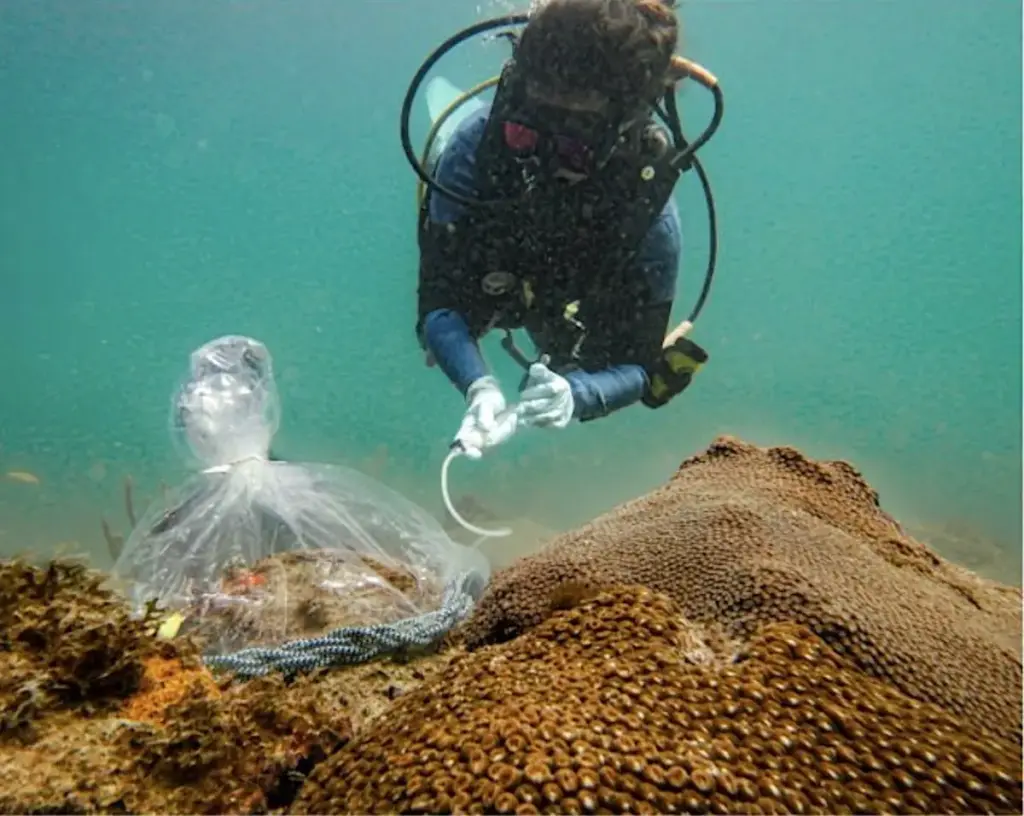
To test the protective capabilities of the compound under realistic marine conditions, researchers applied the probiotic to great star coral, scientifically known as Montastraea cavernosa, utilizing two distinct application methods. The first method involved injecting the probiotic directly into seawater contained within a specially weighted bag placed snugly around the coral colony. The second approach relied on a medicated paste applied directly to the active, disease-related lesions on the coral surface.
The bagging approach was specifically designed by the research team to test the efficacy of a whole-colony treatment strategy. Following the initial applications, the scientific team closely monitored the treated corals and periodically tested coral samples over an extended period of two and a half years to gauge both immediate and long-term impacts.

The results of the long-term monitoring revealed a stark contrast between the two treatment techniques. As reported by Mongabay News, the corals treated via the whole-colony bagging method lost only about 7% of their total tissue to the disease over the study period. In comparison, untreated control corals suffered devastating losses, shedding an average of 35% of their tissue to stony coral tissue loss disease. Furthermore, these protective results proved remarkably enduring, with the probiotic treatment continuing to slow the spread of the disease for the full two and a half years following the initial application.
Conversely, the targeted paste application applied directly to individual lesions did not demonstrate a comparable level of effectiveness in halting the progression of the disease across the wider coral structure.
Encouraged by the success of the whole-colony approach, the researchers worked to develop a practical methodology for applying the probiotics to corals via scuba diving operations. They also confirmed through rigorous testing that this underwater application method would not adversely disrupt other healthy Caribbean coral species inhabiting the surrounding marine ecosystem. This crucial safety check paves the way for a potentially viable and safe SCTLD treatment protocol for full coral colonies in future restoration efforts.
“While the whole-colony bagging method does involve more material transport by divers and more time for deployment and retrieval, its performance at treating SCTLD and promoting long-term resistance outweigh these costs and is therefore the recommended application method of those we tested for probiotic treatments such as the McH1–7 strain,” the study’s authors wrote.
Despite the promising outcomes, the authors strongly emphasized that a significant amount of additional research remains necessary before this experimental treatment can be widely deployed as a standard management tool in the field. They noted that supplementary studies should be conducted to uncover and refine additional treatments capable of addressing the various other coral species that are currently vulnerable to the deadly stony coral tissue loss disease.
“It’s important to understand that this is the very beginning,” Kelly Pitts, lead author of the study and a researcher at the Smithsonian Marine Station, told Mongabay News. “This is definitely not a cure-all, but we’re definitely moving in the right direction.”