Researchers exploring the deepest, most remote environments on Earth have made a groundbreaking discovery in the pitch-black depths of the ocean. Operating a manned submersible, a scientific team has uncovered thousands of mollusks, tubeworms, and other marine invertebrates thriving nearly six miles below sea level in the Mariana Trench and neighboring underwater valleys.
Published in the prestigious journal Nature, the new study details the discovery of the deepest and most extensive animal colonies ever observed by science. While previous explorations of hadal trenches—the deepest regions of the ocean spanning depths below 6,000 meters—have occasionally documented single-celled organisms, finding complex, macroscopic animal life in such crushing, sunless conditions challenges long-held assumptions about the limits of biology on Earth.
"Hadal trenches, some of the Earth’s least explored and understood environments, have long been proposed to harbour chemosynthesis-based communities," the study’s authors wrote in their findings. "Despite increasing attention, actual documentation of such communities has been exceptionally rare. Here we report the discovery of the deepest and the most extensive chemosynthesis-based communities known to exist on Earth during an expedition to the Kuril–Kamchatka Trench and the western Aleutian Trench using the manned submersible Fendouzhe."
The manned submersible Fendouzhe, operated by the Institute of Deep-sea Science and Engineering under the Chinese Academy of Sciences, made 23 dives into the western Pacific’s Mariana Trench during the expedition. To put the depth into perspective, the Mariana Trench extends far deeper beneath the surface than Mount Everest rises above it.
A Vibrant Oasis in the Deep-Sea Desert
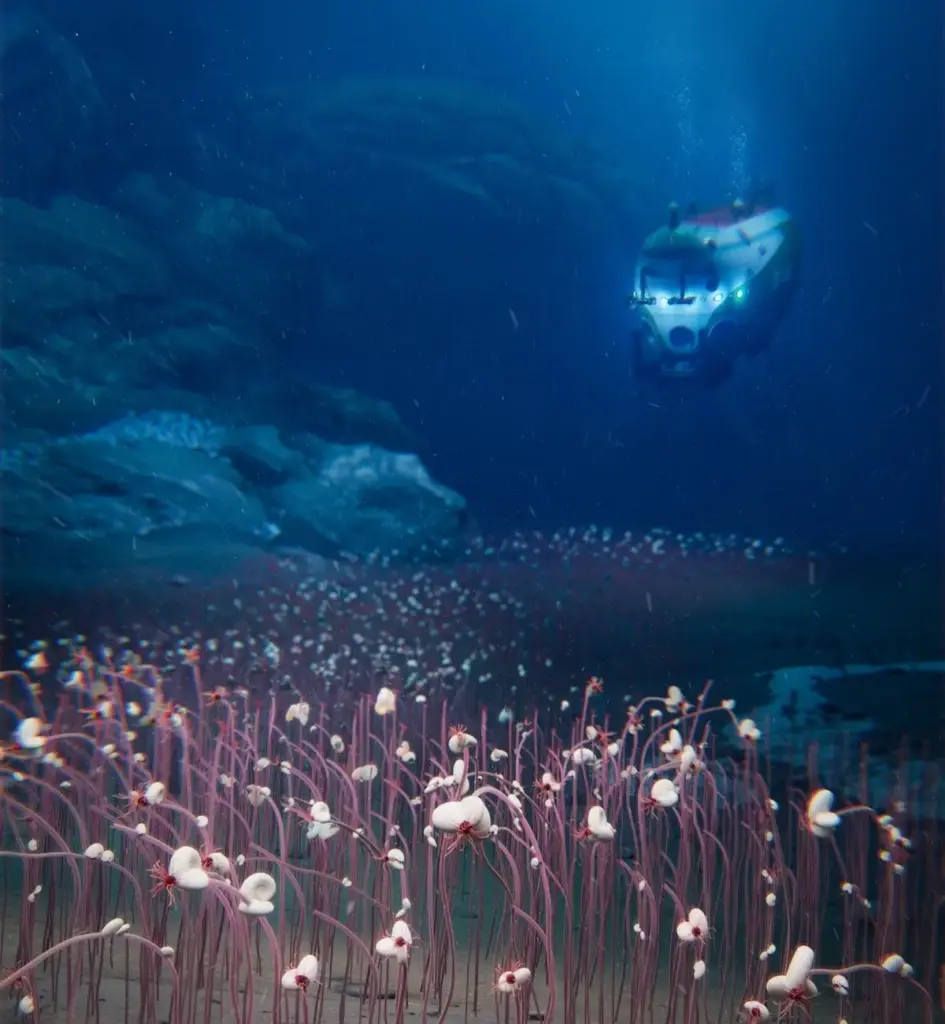
At depths ranging from 3.6 to nearly 5.9 miles, complete darkness prevails. Without sunlight, photosynthesis is impossible, meaning traditional marine food webs fueled by surface algae and plants cannot exist. Instead, the newly discovered communities—primarily consisting of siboglinid polychaeta worms and bivalves spanning a staggering distance of over 1,550 miles—rely entirely on chemosynthesis.
These organisms draw their sustenance from hydrogen sulfide-rich and methane-rich fluids. According to isotopic analysis conducted by the research team, these chemical compounds are transported along active faults traversing deep sediment layers within the trenches, where methane is produced microbially from organic matter that has drifted down from upper ocean layers over millennia.
"What makes our discovery groundbreaking is not just its greater depth—it’s the astonishing abundance and diversity of chemosynthetic life we observed," said study co-author Mengran Du, a marine geochemist with the Institute of Deep-sea Science and Engineering, as reported by Reuters. "Unlike isolated pockets of organisms, this community thrives like a vibrant oasis in the vast desert of the deep sea."

Video footage released alongside the study reveals dense fields of tubeworms growing up to a foot long, accompanied by sprawling mounds of clams and mollusks. Scientists also documented free-floating marine worms, spiky crustaceans, sea lilies, sea cucumbers, and various other invertebrates clustering around snow-like microbial mats. The research team noted compelling evidence that microbes are actively producing methane in these sediment layers, sustaining the dense biological networks above them.
Lead author Xiatong Peng noted that the geological similarities shared across various hadal trenches suggest that these chemical-eating communities may be far more widespread across the globe than previously anticipated. This realization fundamentally challenges current models of deep-ocean carbon cycling and forces marine biologists to reevaluate how life adapts to extreme limits across the planet’s hidden ecosystems.
Echoes of Past Exploration and Modern Threats
The hostile environment of the Mariana Trench has fascinated explorers for decades, though very few humans have ever witnessed it firsthand. While the first historic descent to the bottom of the crescent-shaped trench took place during a brief expedition in 1960, only a handful of crewed missions have successfully returned since. Among them was Hollywood director James Cameron, who completed a solo dive in 2012, later describing the forbidding landscape as "desolate" and "alien."
For modern researchers like Mengran Du, the experience of descending into the abyss offers a profound sense of temporal and spatial displacement. "Diving in the submersible was an extraordinary experience—like traveling through time," Du said. "Each descent transported me to a new deep-sea realm, as if unveiling a hidden world and unraveling its mysteries."
However, this newly illuminated realm faces contemporary pressures from human activity on the surface. The publication of these findings coincides with intense international debates regarding deep-sea mining. As governments and commercial entities eye the ocean floor for valuable minerals, ocean scientists have repeatedly warned that industrializing the deep sea could irreversibly devastate fragile marine ecosystems in one of the last truly wild, undisturbed zones on Earth. Despite ongoing negotiations, the International Seabed Authority has yet to establish comprehensive regulatory frameworks to govern the burgeoning deep-sea mining industry.
As researchers continue to analyze data from the Fendouzhe expeditions, the discovery underscores how much of Earth’s biosphere remains completely unknown. Far from being dead, barren zones, the deepest trenches of the world’s oceans harbor resilient, complex webs of life sustained by the raw chemical energy of the planet’s interior.