For aviation enthusiasts, researchers, and makers worldwide, tracking aircraft has long relied on a familiar setup: a Raspberry Pi connected to a software-defined radio (SDR) USB dongle, running open-source decoding software like dump1090. While these community-maintained ground stations have successfully fed global data networks like FlightAware, FlightRadar24, and airplanes.live for years, they often remain bulky, power-hungry, and ill-suited for portable or embedded applications. Seeking a more accessible and efficient alternative, developer John McNelly created ADSBee, an open-source, low-power ADS-B receiver built around a novel demodulator that brings commercial-grade aircraft tracking to compact hardware.
To understand the significance of the project, it helps to look at the underlying technology. Automatic Dependent Surveillance—Broadcast (ADS-B) is the protocol airplanes use to continuously transmit their precise location, altitude, velocity, and other flight data to air traffic control and surrounding aircraft. Operating on the 1090MHz frequency via a pulse position modulation protocol known as Mode S, ADS-B has become an internationally adopted standard over the decades.

Crucially, the protocol is unencrypted. This openness has allowed aviation buffs, hobbyists, and researchers to build hardware and software solutions to decode, archive, and share flight data globally. Beyond tracking commercial airliners, private jets, or high-profile aircraft, ADS-B data serves critical academic and operational roles. Researchers use aircraft-derived wind data to validate global weather models, while others map GPS spoofing and jamming incidents worldwide. Crash investigators and airline route planners also rely heavily on the vast telemetry archives generated by community ground stations.
Most of this data is gathered by thousands of decentralized ground stations operated by volunteers. However, existing open designs typically require separate computing hardware and SDR dongles, increasing power consumption and physical footprint. Meanwhile, commercial off-the-shelf alternatives built on expensive field-programmable gate arrays (FPGAs) often cost $350 or more, putting them out of reach for many hobbyists and embedded developers.

ADSBee changes this landscape by utilizing a novel demodulator designed specifically for the RP2040 microcontroller and its Programmable Input/Output (PIO) peripherals. This architecture allows the ADSBee 1090 board to perform high-efficiency ADS-B decoding without needing an external computer or an expensive FPGA. Operating at a modest power draw of around one watt and sporting a tiny physical footprint, the device can output aircraft data across a variety of interfaces, including USB, UART, Wi-Fi, and Ethernet via accessory boards. This versatility allows developers to feed flight data into everything from tablets and online databases to drone autopilot flight computers.
The project’s open-source nature stands in sharp contrast to commercial ADS-B transponders and portable receivers, which are permanently installed in full-size aircraft and subject to strict certification regimens. Because portable receivers intended for ground or hobbyist use do not face the same regulatory burdens, many commercial units rely on proprietary, closed-source firmware and hardware. These commercial systems can be slow to update, expensive, and vulnerable to hidden bugs that persist for years.

By open-sourcing both the schematics and the firmware, McNelly has cultivated an active community of beta testers who quickly identify bugs, suggest optimizations, and propose new features. Users have contributed valuable improvements, ranging from advanced configuration commands to refined aircraft position filtering algorithms, driving rapid evolution of the platform.
The ADSBee project has evolved significantly since entering its beta phase. In mid-2025, the project expanded with the introduction of the ADSBee 1090U, a dual-band capable hardware variant. While the original ADSBee 1090 processes packets on the standard 1090MHz frequency, approximately five percent of aircraft in the United States transmit ADS-B data on a separate frequency band at 978MHz using Universal Access Transceiver (UAT) protocols. The dual-band hardware incorporates an additional radio and microcontroller on the same compact PCB form factor, enabling simultaneous reception on both frequencies and opening the door to decoding other aircraft protocols in the future.

Hardware expandability is a central pillar of the ecosystem. McNelly’s accessory boards—affectionately dubbed "pants" by beta testers after his small business, Pants for Birds LLC—connect to the main board via standard 0.1-inch pin headers. This modular approach allows users to build custom add-on boards using simple protoboards. Current and planned accessories include a Power-over-Ethernet (PoE) board for combined data and power delivery, a GNSS board to provide real-time receiver positioning data, and a battery board for fully portable field operations without a tethered USB cable. Future firmware updates are slated to introduce custom GPIO functions to support battery voltage sensing and charge control on custom hardware extensions.
For space-constrained applications, the single-band ADSBee m1090 solder-down module allows developers to integrate ADS-B decoding capabilities directly into custom printed circuit boards.

Beta testers and community members have already deployed ADSBee hardware in creative and demanding scenarios. In the Czech Republic, builder Petr Čada integrated an ADSBee into his T1 Ranger first-person-view (FPV) remote-controlled aircraft. By reporting air traffic data to the flight controller over the MAVLINK protocol, real-time traffic alerts appear directly on his video feed as an on-screen display overlay, warning the pilot of nearby air traffic.
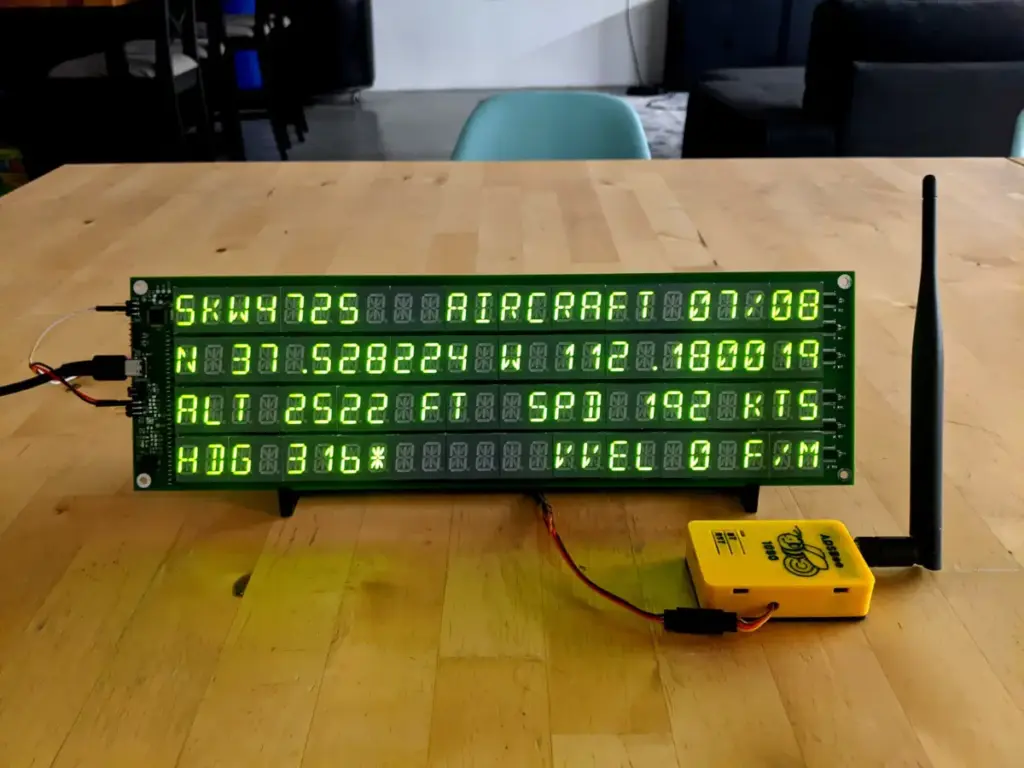
In California, builder Steve Mo constructed a sophisticated 14-segment flight display powered by an STM32F103 microcontroller. Connected to an ADSBee via UART and MAVLINK, the hardware cycles through nearby aircraft within range, displaying telemetry including latitude, longitude, altitude, vertical rate, airspeed, and heading. Steve also developed a custom WS2812 LED panel driven by an ADSBee to present dynamic facts about passing aircraft.

Another California beta tester, Ryan Null, addressed the challenge of remote roof installations by developing a solar- and battery-powered ADS-B ground station. Thanks to the ADSBee’s low power consumption, the setup operates reliably on a modest solar panel and lithium-polymer battery bank, even in partial shade. Ryan has continued refining the design to incorporate larger solar arrays, Maximum Power Point Tracking (MPPT) controllers, and higher-capacity batteries to sustain operation through darker winter months.
At public exhibitions like the Open Sauce convention in San Francisco, McNelly and fellow builder Jeff Hendrix showcased a miniature cockpit instrument panel featuring live ADS-B moving maps. Developed in collaboration with FPVToys.net, the setup renders live air traffic and nearby airport layouts onto tiny, functional instrument displays housed within a 3D-printed shell. Controlled via a custom keypad, the miniature cockpit demonstrates how low-power, open-source hardware can bring complex aviation telemetry into scale model environments and desktop displays.

As the community continues to grow through active Discord channels and regular project updates, makers are finding new ways to deploy open-source flight tracking technology. Whether mounted in an attic, integrated into an autonomous drone, or displayed on a custom LED matrix, ADSBee demonstrates how open hardware principles can make aviation data more accessible, hackable, and affordable than ever before.