


Long before she became an immortalized cinematic icon as Princess Leia in the Star Wars franchise, Carrie Fisher was Hollywood royalty by birth. The daughter of silver-screen musical star Debbie Reynolds and charismatic singer-actor Eddie Fisher, Carrie grew up under the blazing California sun, surrounded by the extraordinary glamour and unique eccentricities of the entertainment industry. In her later years, Fisher and her mother forged a bond so close that they became practically inseparable, residing side-by-side in the Hollywood Hills—an arrangement that mirrored the deep, lifelong connection they shared both personally and professionally.
Fisher lived in a charming, Spanish-style estate perched high in the Hollywood Hills, and her mother, at Fisher’s direct urging, moved into the neighboring cottage on the property. Their living situation was exceptionally warm and supportive. Reynolds once reflected on the setup, noting how wonderfully convenient it was to have her daughter close by while also affording her precious time with her granddaughter, Billie Lourd, and her son, Todd Fisher, who lived just a short distance away.
Their profound, sometimes intensely intertwined relationship was memorably captured in the 2016 HBO documentary Bright Lights: Starring Debbie Reynolds and Carrie Fisher. In the film, the Star Wars actor famously remarked on their telepathic-like closeness, stating that she was her mother’s best friend and knew what Reynolds felt and wanted far more than she might have ever preferred.

Tragedy struck later that same year in a devastating one-two punch that deeply shook Hollywood and millions of fans worldwide. While on a commercial flight, Fisher suffered a massive cardiac arrest at the age of 60 and passed away days later. In an agonizing turn of events, Reynolds suffered a stroke and died the very next day at the age of 84. Her brother Todd later explained to television news program 20/20 that their mother simply could not bear to leave Carrie behind and did not want her to be alone.
Although Fisher—who would have celebrated her 70th birthday—was closely tied to her family, her homes were always bustling, vibrant spaces. Reflecting on her chaotic and lively domestic life in a 2004 interview with Architectural Digest, Fisher quipped, "There’s been anything and everything holed up in this Hollywood-style hacienda."
The Fisher Family Beginnings
Carrie was only about 18 months old and living in the greater Los Angeles area when a classic 1958 family photograph captured her sitting on her father’s lap next to Reynolds, who was holding an infant Todd. The siblings were born to Reynolds, renowned for her legendary starring role in Singin’ in the Rain, and Eddie Fisher. Prior to Todd’s birth on February 24 of that year, the growing family relocated to a sprawling residence on Conway Avenue in the exclusive Holmby Hills neighborhood.

In her memoir Debbie: My Life, Reynolds detailed the search for more space, recalling that they ultimately settled on a white-brick, two-story, four-bedroom home. It was a spacious property featuring a large family room and a grand bay window that looked out over a sparkling swimming pool and an expansive rose garden.
New Beginnings and Beverly Hills Estates
The domestic stability of the early years was short-lived. Fisher’s parents divorced in 1959 after Eddie Fisher left Reynolds for Elizabeth Taylor, a Hollywood scandal that erupted following the tragic death of Taylor’s husband, Mike Todd. Following the separation, Carrie and her brother moved with their mother into a sprawling Beverly Hills estate owned by Reynolds’s second husband, the successful businessman Harry Karl.
According to recollections shared by Carrie, Karl’s residence felt far less like a warm, traditional family home and "more like a place where you would get your passport stamped." The grand estate was equipped with three swimming pools and a massive five-car garage that regularly housed at least two Rolls-Royces. Both Carrie and Todd were given their own bedrooms complete with marble en suite bathrooms, and the home boasted a private projection room large enough to rival a small commercial movie theater.

An At-Home Wedding and a Memorable Keepsake
As an adult carving out her own path, Fisher’s romantic life frequently intersected with her distinct taste in interior design. At age 26, she married acclaimed musician Paul Simon during an intimate, private ceremony in New York City. The Washington Post reported that the wedding, held inside Simon’s apartment on Central Park West, drew an elite crowd of guests, including Carrie’s famous parents, alongside music and film luminaries such as Billy Joel, George Lucas, Mike Nichols, Randy Newman, Robin Williams, Christie Brinkley, and Simon’s legendary musical partner, Art Garfunkel.
Although Carrie and Paul’s marriage lasted less than a year, her emotional connection to a specific piece of decor from that era endured for decades. When Architectural Digest visited the actor’s final home in the Hollywood Hills, an exquisite Muller Frères lamp sat prominently on her living room Steinway piano. Fisher explained that the lamp had always represented her marriage to Paul. During heated moments when the couple was separating and meant it, she would pack no luggage—she would simply take the $25,000 lamp that she had acquired during a manic shopping spree.
A House with History
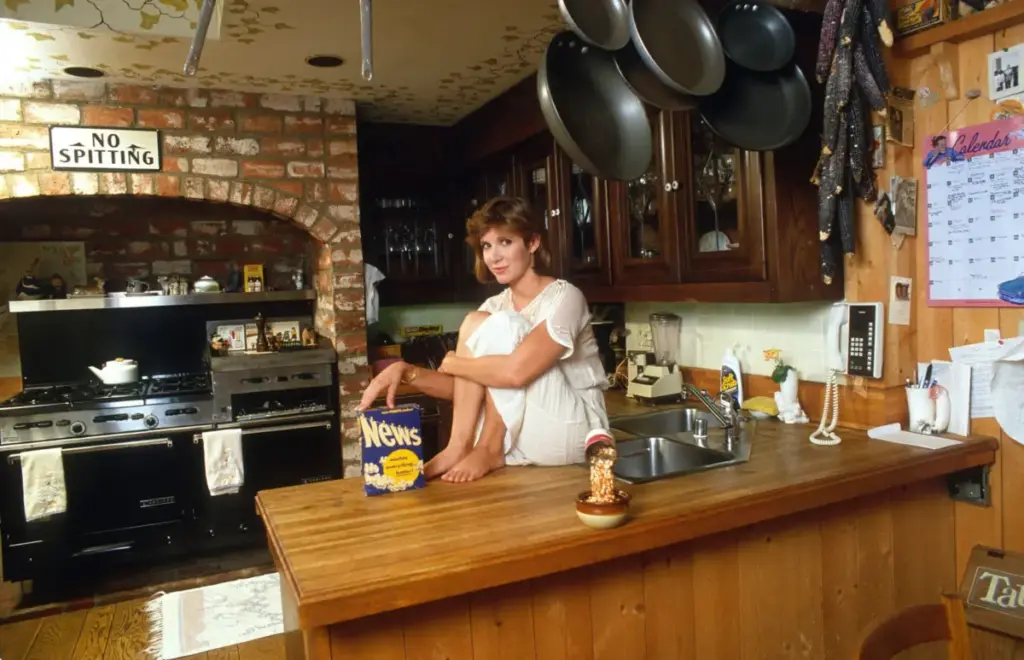
Roughly a year after reprising her career-defining role as Princess Leia in 1983’s Return of the Jedi—and famously gracing the cover of Rolling Stone magazine in the character’s iconic metal bikini—Fisher purchased her own piece of Los Angeles real estate. She bought a 2,600-square-foot home from Starsky & Hutch actor David Soul for $925,000.

Situated on approximately one acre of land, the three-bedroom property included a sauna, a swimming pool, and a dense, lush forest of bamboo. Over the years, the storied property passed through several notable hands, including Creative Artists Agency co-chairman Kevin Huvane and filmmaker Roberto Sneider, before actor Channing Tatum acquired it for $6 million in 2015.
Finding Her Light Through Writing
By 1987, Fisher was living in her Los Angeles home and aggressively expanding her creative horizons into literature. That year, she published her semi-autobiographical debut novel, Postcards from the Edge, which instantly climbed the bestseller lists and cemented her reputation as a sharp, fiercely witty writer.
Despite her deep roots in Southern California, Fisher maintained a complicated relationship with Los Angeles. While she told the Los Angeles Times that the city never drove her completely "crazy," she frequently felt like an outsider who struggled to fit in. She admitted that she didn’t dress right, didn’t look right, and often felt disconnected from the prevailing values of the local community. In her writing, she offered a characteristically cynical observation about the local culture, noting that true closeness was difficult to find in Hollywood because everyone excelled so brilliantly at faking it.

A Whimsically Western Hideaway
Fisher ultimately stamped her own irrepressible personality onto her estate, transforming it into a whimsical, deeply personal sanctuary. In a September 1990 feature for Interview magazine, writer Lisa Liebmann described Fisher’s property as featuring a "whimsically Western motif" both inside and out.
The entrance featured a driveway gate adorned with a painted rodeo scene and a quirky plaque bearing the inscription, "Wow! That Was Some Cup of Coffee Institute of Alternative Life-Styles." The expansive grounds included a swimming pool lined with natural rocks and a treehouse bearing a warning sign that read "Beware of Trains." Fisher even kept a faux cow in the backyard. The playful, eccentric atmosphere was so palpable that when actor Jack Nicholson visited the property, he famously surveyed the whimsical decor and asked just how old the children living there were—years before Fisher gave birth to her only child, Billie Lourd.
An Animal House
During her years in Beverly Hills, Fisher shared her living space with a menagerie of beloved pets, including a Jack Russell terrier named Buddy and a pair of talking parrots named Dean and Joan. She expressed an affinity for dogs and birds, noting her allergy to cats, and often found humor in the behavioral quirks of her avian companions.

The parrots routinely engaged in what Fisher playfully dubbed "the Phone Call from Venus," mimicking her phone conversations word-for-word. While she admitted it could occasionally become as noisy and annoying as having screaming children in the house, there were charming moments as well. Joan, one of the talking parrots, apparently enjoyed visiting Fisher while she was in the bathtub and even possessed a penchant for singing opera.
An Eternal Bond and Family Legacy
Following the heartbreaking passings of both Carrie Fisher and Debbie Reynolds in late 2016, their adjacent Beverly Hills properties hit the real estate market together as a combined 3.5-acre estate priced at $18 million. However, the younger generation chose to preserve the family’s deep ties to the property.
In a 2017 interview with Town & Country, Billie Lourd revealed that she had ultimately decided to keep her mother’s home. Describing the estate as magical and profoundly special, Lourd chose to move in with a few close friends, recreating a warm, communal living arrangement reminiscent of the family’s history on the property.

Fabulous Furnishings and a Welcoming Host
When Fisher moved into her final permanent home in 1993, the relocation was driven less by a desire for a specific neighborhood and more by the sheer volume of her belongings. She told Architectural Digest in 2004 that she had accumulated so much stuff that she simply had to live in a place where her furniture wanted to go.
The sprawling residence carried its own rich Hollywood pedigree, having previously belonged to King Kong actor Robert Armstrong, legendary screen icon Bette Davis, and Oscar-winning costume designer Edith Head. Fisher filled the historic space with oversized 1930s leather club chairs, folk art, and vibrant Indian rugs. Later, to accommodate her daughter’s modern aesthetic, she integrated bubble and egg chairs alongside a pillowy, fake-suede sofa by Michel Ducaroy in the den, where a plasma TV cleverly rose from a wooden window seat.
True to her generous and eclectic spirit, Fisher frequently opened her doors to those in need of shelter, solace, or community. Her guesthouse regularly accommodated an assortment of friends, artists, addicts, individuals battling serious illnesses, and those simply passing through Hollywood. In a testament to the home’s unusual character and creative acoustics, musician James Blunt even recorded a song in the estate’s bathroom because an upright piano had to be stored there due to a lack of space elsewhere. It was, as Fisher often noted, simply one of those houses that worked its own unique magic on everyone who crossed the threshold.