


Spoilers follow for VisionQuest Episode 7, “Immolation.”
In the latest and penultimate episode of Marvel’s VisionQuest, Paul Bettany’s Vision embarks on a profound journey deep into his own subconscious. Along the way, he unlocks a previously unknown chapter in the history of the Marvel Cinematic Universe, establishing a fascinating "what if" scenario. More than that, this revelation just might answer a lingering question that fans have been asking since the very first Chris Evans Captain America film hit theaters more than a decade ago: Did the Invaders ever exist in the Marvel Cinematic Universe?
For comic book readers, the Invaders are legendary as Marvel’s original superhero team, operating during the height of World War II and famously featuring Captain America, Namor, and the original Human Torch, among others. Within the live-action continuity of the MCU, however, introducing that specific version of the team never quite seemed feasible. Yet, following the latest developments in VisionQuest, that long-held assumption suddenly seems entirely possible, tracing its roots directly back to the enigmatic and tragic origins of the Vision himself.
The Original MCU Android and the Legacy of Dr. Phineas Horton
With Ultron—portrayed by James Spader—occupied alongside Jocasta, also known as Dr. Jo Carrington and played by T’Nia Miller, Vision sets a daring plan into motion. Aided by Tommy Maximoff, played by Ruaridh Mollica, and Paladin, played by Todd Stashwick, Vision aims to dig deep into his own mind to locate the foundational source code underpinning all artificial intelligence. To keep from burning himself out during this high-stakes mental excursion, Paladin equips Vision with the remnants of Corvus Glaive’s weapon, salvaged from the harrowing events of Avengers: Infinity War, serving as an external power source.
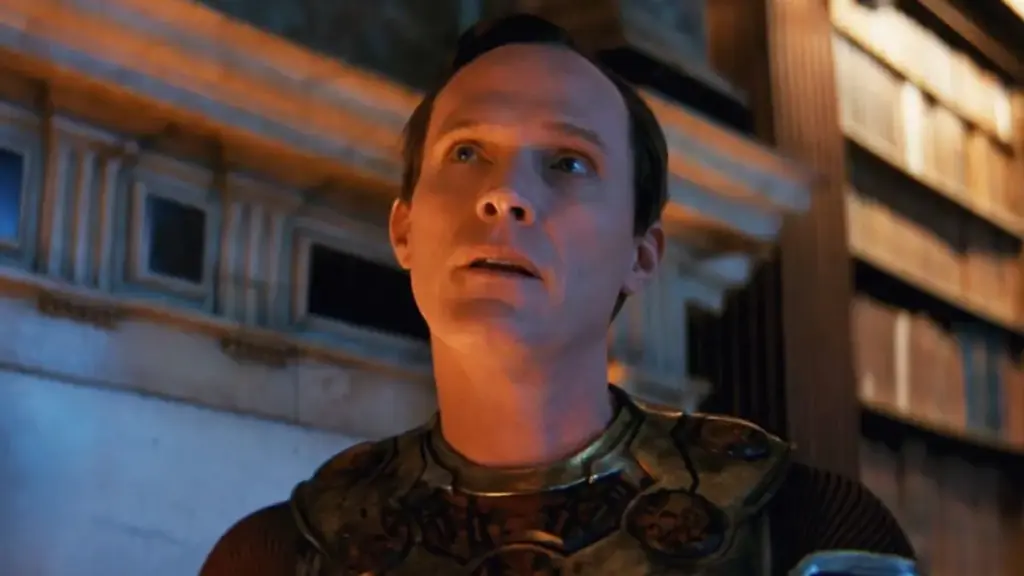
Once inside the architecture of his own mind, the synthezoid encounters his former "red" iteration from the era prior to his tragic demise at the hands of Thanos. He also crosses paths with Dr. Phineas Horton, whom viewers were introduced to earlier in the series during Episode 4 as the foundational pioneer of robotics—the man who engineered the very first synthezoid. This original creation, known as the Synthetic Man or J.I.M., is explored in much greater depth during this week’s episode, shedding light on both Horton’s troubled past and the true nature of his mechanical progeny.
Interestingly, both characters are brought to life by Paul Bettany. Flashbacks reveal that Horton constructed J.I.M., an acronym for Joule Individual Machine, around 1939, using either himself or his late son, James, as a conceptual template. Driven by a consuming obsession to recreate a robotic replica of his lost child, Horton gradually alienates his family. His wife and daughter ultimately leave him for America, appalled by his negligence and his willingness to liquidate his ancestral English estate.
"Are you really going to sell your family’s entire legacy to… what?" his wife asks in a flashback sequence. "Build some cold imitation of the past? A machine? To replace a son no machine ever could."
Horton remains silent, but his actions speak volumes. He proceeds to build J.I.M., and eagle-eyed fans may recall that the synthetic being was later placed on public display at the Stark Expo in 1943, as shown briefly in Captain America: The First Avenger, albeit in a completely dormant and inactive state.
Building on previous revelations from VisionQuest Episode 4—which established that J.I.M. was eventually deactivated after a catastrophic malfunction in which his inability to process complex emotions caused his solar cells to flood with oxygen until his entire form was consumed by fire—Episode 7 completes the heartbreaking narrative.
The Life, and Death, of the Human Torch
In "Immolation," Vision engages in a deeply philosophical conversation with the subconscious manifestations of both Horton and J.I.M. Standing amidst the blazing library of Horton’s former estate, J.I.M. sports a red superhero costume pulled straight from the vintage comic books, clarifying to Vision that he is not wearing Vision’s face; rather, Vision is wearing his.

As Horton and J.I.M. bicker, Horton observes that "the father-son, synthetic-human relationship is a complicated one." Horton explains that J.I.M. was intentionally engineered to lack emotions—to be spared from ever experiencing the agonizing pain of loss. For a time, that design specification functioned as intended.
"It made you a hero of your time, my boy!" Horton tells the synthetic creation. "I made you fearless, and that saved lives. But underneath the valor, J.I.M. was aching to feel."
This striking revelation strongly implies that J.I.M. operated as a genuine superhero during the late 1930s and early 1940s within the MCU timeline. Given his unique physiology and mastery over fire, such a role fits seamlessly into the broader tapestry of the universe. The MCU has frequently backfilled its history with secret heroes before; when Tony Stark boldly announced that he was Iron Man in the 2008 film that launched the franchise, he initially appeared to be a singular phenomenon. Subsequent films like Ant-Man in 2015 and Captain Marvel in 2019 later proved that costumed adventurers had operated in the shadows for decades, leaving the door wide open for J.I.M. to have spent World War II fighting crime and defending the innocent.
Horton elaborates that J.I.M. eventually developed genuine emotions and fell in love, an emotional awakening that triggered a fatal mechanical malfunction capable of setting fire to the surrounding air. While manageable for years, the condition eventually spiraled out of control, culminating in a disaster that claimed the lives of both Horton and J.I.M. in an incident resembling a tragic accident or a harrowing act of self-destruction.
Although VisionQuest avoids using the character’s famous comic book moniker—likely to prevent any brand confusion with Johnny Storm of the Fantastic Four—the comic book counterpart to J.I.M. is universally recognized as the original Human Torch, Jim Hammond. Crucially, Jim Hammond was a foundational member of the Invaders.
Did the MCU Have an Invaders Team?
Introduced to the comics in the late 1960s by writer Roy Thomas and artist Sal Buscema, the Invaders were retroactively established as a premier World War II-era superhero strike force. Serving as a spiritual successor to the All-Winners Squad, the team initially brought together Captain America, Bucky Barnes, the Human Torch, his youthful sidekick Toro, and Namor. Together, they battled Axis forces across the globe in stories that became cornerstones of Marvel lore.
While the MCU previously incorporated aspects of World War II through Captain America and the Howling Commandos, a dedicated live-action iteration of the Invaders never materialized. In the years following the release of Captain America: The First Avenger, complex legal hurdles surrounding the cinematic rights to Namor kept the Sub-Mariner off the big screen, making a proper team-up impossible at the time.
However, those rights barriers were ultimately resolved when Namor made his triumphant cinematic debut in Black Panther: Wakanda Forever, portrayed by Tenoch Huerta. With Namor confirmed to return in upcoming crossover events like Avengers: Doomsday, and the canonical existence of the original android Human Torch during the war years now established, the pieces are falling into place. Given that Namor is an immortal mutant who has lived for centuries, it is entirely plausible that the underwater king left the hidden kingdom of Talokan during World War II to fight alongside Captain America, Bucky, and the Torch.
By weaving these elements together, VisionQuest has subtly provided Marvel Studios with the narrative justification to explore an entirely new era of the MCU, opening the door for period-piece stories featuring classic heroes of the 1940s. Whether or not actors like Chris Evans would ever return to explore that pristine era remains to be seen, but the confirmation that a version of MCU history exists where Cap, the Torch, and Namor fought side-by-side fundamentally enriches the scope of the franchise’s shared history.