

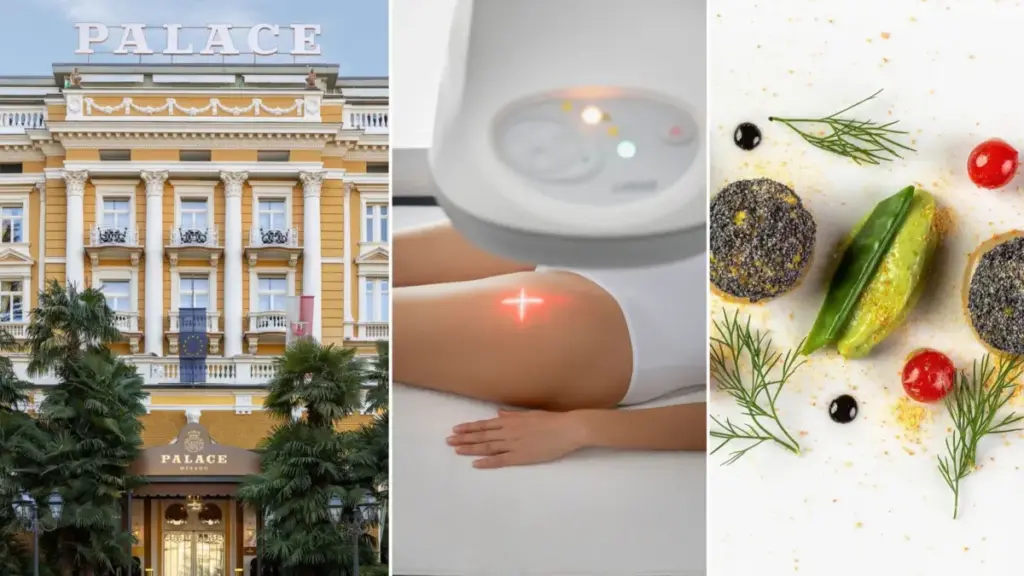
Stepping through the doors of Palace Merano after an exhausting early-morning flight to Venice and a four-hour drive through the northern Italian landscape, I was utterly famished. My immediate cravings were simple: to collapse into a soft hotel bed and hunt down a satisfying snack. Anticipating a spread of fresh fruit, a fully stocked minibar, or a tray of complimentary sweets, I began looking around my room. Instead, I found nothing. There were no nectarines, oranges, or grapes waiting on a polished tray. I pulled open the doors of the grand armoire, only to discover a large bottle of mineral water and a modest selection of caffeine-free herbal teas. There was no coffee machine in sight, let alone a steaming cup of morning espresso.
I took a deep breath, reminding myself that this ascetic welcoming was entirely by design. I had arrived to participate in Palace Merano’s signature Revital Method, an intensive house detox protocol overseen by Dr. Massimiliano Mayrhofer, the scientific director and a distinguished physician specializing in regenerative medicine. Set in South Tyrol near the Italian Dolomites, the storied wellness retreat has drawn dedicated regulars every winter for decades to undergo its comprehensive physical and mental reset. Designed to boost each participant’s overall performance while actively slowing the aging process, a standard four-day program starts at $3,900, with accommodations priced separately and rates scaling upward based on duration, room choice, and seasonal demand.
The historic setting itself exudes a timeless grandeur. The Belle Epoque-style property was initially constructed in 1906 to serve the European aristocracy who flocked to the sheltered Alpine valley at the turn of the century. Today, it operates as a sophisticated sanctuary where centuries-old European wellness traditions meet modern longevity science.

The Medical Intake and Designing the Journey
As is mandatory for every guest who checks into the property, my first official appointment was a thorough medical consultation. Dr. Sabrina Ebner walked me through what my next five days would entail, mapping out a rigorous schedule of morning acupuncture, specialized hydrotherapy, targeted massage treatments, and specialized afternoon appointments. We discussed my personal detox goals, which largely revolved around undoing the physical toll of a summer defined by heavy wine, rich pasta, and intense exposure to UV rays.
However, my primary motivation for making the journey was the property’s emerging neuro-wellness offerings. At my specific request, Dr. Ebner incorporated cognitive testing into my itinerary alongside a comprehensive body composition scan. She handed me a small, unassuming brown binder—a physical passport that I would hand to every practitioner I encountered throughout the week so they could meticulously catalog my progress.
When I fanned open the pages to review the week ahead, I felt an overwhelming sense of relief. There was no mandatory sunrise breathwork, no high-intensity ecstatic dance classes, and no forced group intention-setting circles. Instead, the schedule featured classic, optional modalities: pilates, yoga, and quiet morning meditations.

While the morning treatments offered the ultimate luxury, the cognitive sessions were what truly promised to deepen my understanding of my own mind and body. My grandmother suffered from Alzheimer’s disease, and by the final chapters of her life, she had become entirely vacant. I had witnessed firsthand what that long, slow decline cost her, my father, and my aunt. As the broader wellness industry increasingly reorients itself around longevity, brain health has naturally taken center stage. Yet my personal interest extends far beyond simply adding more years to my life; I want to understand how to preserve and optimize my cognitive function as I age.
What to Expect from a Neuro-Wellness Retreat
The neuro-wellness protocol at Palace Merano is distinct from the trendier wellness retreats where guests are forced to surrender their smartphones at check-in to rediscover an analog inner world. While I certainly used my phone far less during my stay and never once opened my computer, the neurological work here is strictly diagnostic. I was not unplugging for the sake of digital abstinence; rather, I was gathering actionable data.
Mindfulness remains a natural component of the broader detox framework, but there is no social pressure to participate in collective rituals or adhere to a rigid spiritual dogma—practices that have become ubiquitous at contemporary wellness hotels. This absence of forced conformity immediately put me at ease. As I moved through the quiet corridors of the property, I noticed a similar calm among fellow guests, many of whom were also traveling alone. It was clear that everyone was being afforded the space and freedom to embark on a deeply personal journey, retreating entirely at their own pace.

Mud Therapy and Magnesium Elixirs
Once Dr. Ebner officially cleared me for all physical activities during my medical checkup, I was escorted to my acupuncture and massage appointments. These were quickly followed by what rapidly became my favorite part of each day—outside of actual mealtimes: the hydro-mud therapy wing.
There, I was greeted by Naique, a staff member who shared that she and almost all of her colleagues in the wing were born and raised right in Merano. She opened the door to a dimly lit treatment room where a steaming bath had already been prepared. After adding specialized essential oil blends tailored to support my detox process, she asked if I would like a magnesium-potassium "energy" drink. When I enthusiastically accepted, she returned a few moments later with a simple paper cup, winking at me and jovially declaring, "Champagne!"
Brain-Health Labs and Dynamic Testing
Given my specific focus on cognitive preservation, Dr. Ebner arranged an afternoon session with Alex, a coach at the Palace’s sports and recovery lab who oversees its cognitive division. While the lab is traditionally utilized by elite athletes seeking to enhance their mind-body connection, a growing number of detox participants are incorporating cognitive testing to sharpen their focus, memory, and overall mental efficiency.

"Our cognitive tests are part of a broader approach to brain health, prevention, and wellbeing," Schwazer explained. "Through exercises involving attention, concentration, and memory, it can help keep certain cognitive functions active while increasing awareness of individual cognitive abilities."
The testing apparatus consisted of a wheeled rack featuring six blue LED pods mounted at staggered heights, each flashing random numbers and symbols. Across three distinct evaluations—testing memory, attention, and reactivity—my task was to track and respond to the stimuli as quickly as possible. Schwazer offered constant encouragement, even when I missed a cue. The better I performed, the faster and more complex the sequence became, as the software was specifically calibrated to find my cognitive breaking point.
Ultimately, my reaction time for attention registered at 251 milliseconds—a metric I had no context for until Schwazer assured me it was "good." A written report provided at the end of the session placed both my attention and memory in the higher range of the average population, a result I readily accepted as a victory. Furthermore, Schwazer provided me with remote access to the Palace’s digital training exercises so I could continue practicing the cognitive drills at home.

Unlike more spiritually oriented retreats that rely on static brain mapping—such as placing electrodes on the scalp to measure electrical activity while sitting completely still—the diagnostic approach at Palace Merano is intensely active, scientific, and mathematical. Schwazer noted that while passive brain mapping can yield interesting insights, it is frequently insufficient because it measures the brain in a dormant state. In contrast, dynamic testing forces the brain into an active state, offering a much more accurate reflection of how it actually functions under pressure.
Nourishing Food and Restful Sleep
Over the subsequent days, I maintained my daily treatment schedule while learning to appreciate the property’s unique philosophy on nutrition. The culinary journey began with a gentle laxative cleanse followed by an overnight fast. Although the staff warned me that the cleanse would be intense, prompting me to brace for a sleepless night, I instead enjoyed eight hours of uninterrupted rest followed by only a mild morning inconvenience. I awoke feeling lighter than I had in months.
Then came the official detox menu, a meticulously crafted low-calorie plan designed to help the body mobilize and eliminate accumulated toxins. If detox menus were eligible for Michelin stars, the offerings at Palace Merano would undoubtedly earn them. I remained genuinely hungry after nearly every meal. At one point, noticing my consistently empty plate, the restaurant manager approached my table and joked, "Miss, if you need more food, ask. This is not a prison." Yet the artful presentation and sophisticated flavor combinations in each dish—ranging from a tapioca pudding artfully shaped like a kiwi to sumac couscous tossed with broccoli, raisins, and almonds—ensured that I savored every single bite.

Following a body composition scan that mapped my precise distributions of muscle and fat, I sat down with Dr. Claudia Arganini, a biologist and nutritionist with a PhD. Although my metrics indicated I was at a healthy weight, I confessed to her that I was increasingly unsure what that even meant in the modern era of constant biological optimization.
"A healthy weight is not defined by a number. It’s about finding balance, feeling good in your body, and building a healthy relationship with food," she told me. "It’s more about learning to treat yourself with greater acceptance and love than anything else."
Her perspective came as an immense relief. I had arrived seeking hard science and quantifiable numbers, yet one of the most valuable takeaways of the week was the realization that metrics are not always the ultimate objective. By the final day of the program, I fully understood why so many loyal guests return to the valley every winter.

Having experienced a wide spectrum of global wellness retreats, I found the clinical precision of the care, perfectly balanced by the warmth and lightheartedness of the staff, to be genuinely refreshing. From the attending physicians to the massage therapists, everyone maintained an approachable levity that prevented the experience from feeling overly clinical. I was not subjected to a punishing weight-loss protocol or a forced spiritual awakening designed to purge my way into wellness.
Instead, I departed with practical, scientifically grounded strategies for improving my long-term health, courtesy of an accessible medical team—along with the delightful memory of local women in the hydro-mud therapy wing handing me paper cups of magnesium and toasting them as champagne. As for my cognitive scores, landing in the upper tier of the average population was not a world-changing triumph, but under the circumstances, it was precisely what I had hoped to hear.