




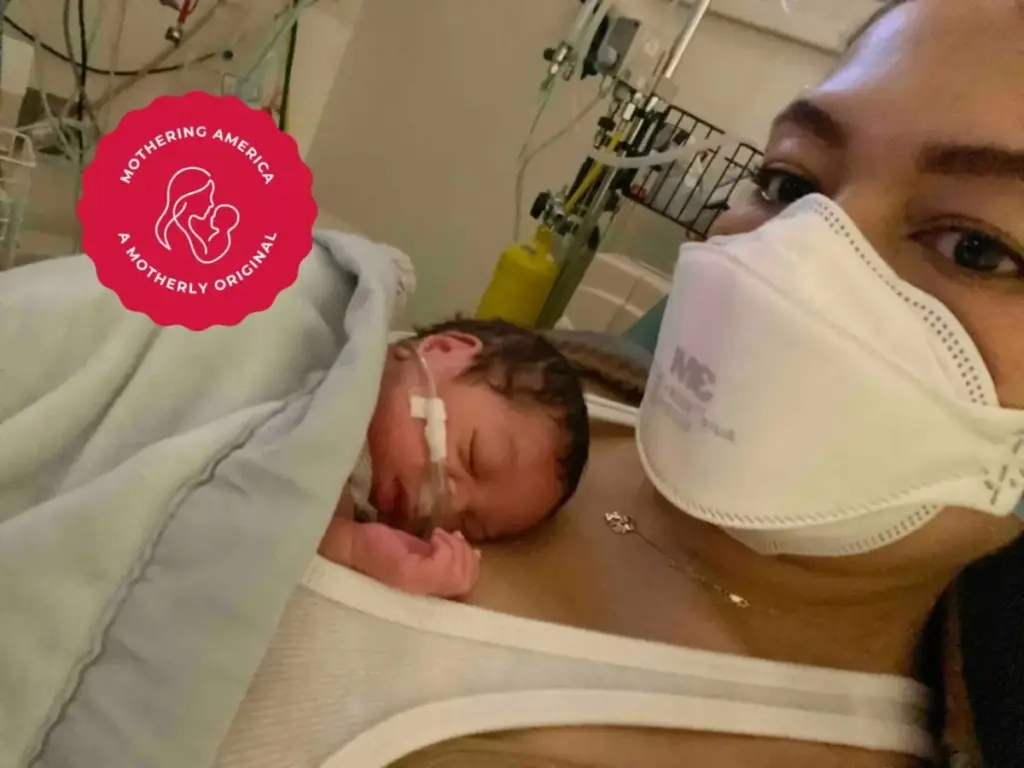
Mothering America is a regular column from Motherly and Chamber of Mothers sharing moms’ stories from across the country, showing the power of coming together to make change. Each piece is part of a larger effort to ensure every mother and family in the U.S. has the support and care to be well.
Stephanie Roberson’s second pregnancy had been entirely textbook. Every routine ultrasound displayed healthy development, and all accompanying test results consistently came back within normal ranges. There was no outward indication that anything might be amiss. Then, on an ordinary evening while she was lying down next to her two-year-old son to help him drift off to sleep, her water unexpectedly broke. She was only 24 weeks pregnant, deep into the second trimester and months away from her projected due date.
Acting quickly and quietly so as not to alarm her toddler, she walked into the bathroom, placed a towel beneath her legs, and immediately placed a call to her physician. Her doctor gave her sobering instructions: she needed to bypass standard medical facilities and get herself directly to a hospital equipped with a higher level of specialized neonatal intensive care.
Reflecting on that harrowing moment, Roberson recalls a vivid detail that remains etched in her memory. When she stepped away, the towel was completely drenched, save for two dry, distinct footprints left precisely where she had been standing.
Because her husband was away traveling for work at the time, logistics became an immediate challenge. Roberson called a neighbor to come over and stay with her sleeping son, while her mother—who happened to be visiting from out of town—drove her through the night to the hospital. As she frantically packed a bag in the dim light of the bedroom, her mind raced with a terrifying, foundational question that haunts countless parents in similar positions: How could a human baby possibly survive being born at just 24 weeks?
Upon arrival at the medical center, the clinical staff delivered the sobering reality of her immediate future. She would be placed on strict, hospital-bound bed rest for the duration of the pregnancy, effectively moving into a clinical room until her son decided to make his entrance. Shortly after her admission, a neonatologist visited her bedside to walk her through the complex landscape of premature infant survival statistics.
While the medical team consistently endeavored to present the prognosis in an encouraging, constructive light, the clinical realities remained deeply frightening. At 25 weeks of gestation, infant survival rates hover around 80 percent, but that statistic carries a massive caveat regarding long-term health.
Roberson was forced to mentally grapple with a wide spectrum of potential outcomes: a child who might not survive delivery at all, a medically fragile infant facing a lifetime of intensive interventions, or a high statistical likelihood of enduring vision, hearing, lung damage, and severely suppressed immunity.
Her mind was intensely focused on the fundamental question of survival, but it was simultaneously overwhelmed by the profound practical and emotional weight of reshaping her entire life to accommodate a child with extensive medical needs. As someone who naturally preferred to organize, plan, and control her environment, Roberson channeled her panic into immediate research. She ordered books detailing prematurity, immersed herself in dense medical terminology, and studied potential developmental challenges and long-term prognoses.
She was driven by a desperate desire to learn as much as humanly possible so she could serve as an effective, knowledgeable advocate for her son once he arrived. Beneath the surface of her frantic preparation, however, she also wrestled with a crushing wave of internalized shame, secretly wondering if her own body had somehow failed her son or if she bore some hidden responsibility for the premature rupture.
After enduring 13 long days of continuous bed rest under constant medical monitoring, Roberson finally went into active labor at 25 weeks and 6 days. By coincidence, her husband was home with their two-year-old at that exact moment, and the delivery progressed with startling speed. The entire sequence of events unfolded rapidly as they left the hospital room at 11:22 in the morning, and her son was born just fourteen minutes later at 11:36.
What 87 days in the NICU looks like
The entire specialized NICU team was present in the delivery room for the birth. As the clinical staff began their initial assessment of the newborn, Myles, Roberson heard a sound that offered her an immediate surge of relief: a distinct, albeit fragile, cry.
The sound was so remarkably tiny and delicate that it genuinely resembled the cry of an infant located several rooms down the hall. Myles also registered surprisingly strong Apgar scores during his initial evaluation. The medical team briefly pressed the infant against her cheek for a fleeting, emotional moment before whisking him away to the specialized unit.
Once inside the Neonatal Intensive Care Unit, the road ahead proved grueling. For the first 77 days of his life, Myles experienced recurring episodes where he simply stopped breathing multiple times every single day. This condition is a frequent, highly stressful complication of extreme prematurity, stemming from an underdeveloped brain that routinely forgets to trigger the automatic reflex to breathe. The standard medical protocol involved administering caffeine to stimulate his immature central nervous system, though there were numerous occasions where nurses had to physically stimulate his tiny body to force him to start breathing again.
For Roberson, the constant shadow of the unknown was undeniably the hardest psychological hurdle to clear. A parent in the NICU simply lives without a script, possessing zero predictability regarding what the future holds or what kind of outcome awaits their child.
The physical and emotional environment of the NICU added its own unique layers of trauma. Monitors beeped and alarmed incessantly around the clock, while families lived in close proximity, inadvertently bearing witness to one another’s deepest fears and heartbreaking tragedies.
Roberson notes that you are constantly surrounded by the raw sounds of medical interventions and alarms, leaving you to sit quietly with a profound, pervasive sense of collective grief. On one particularly searing day, she watched helplessly as another family brought in an entire delegation of extended relatives into the unit simply to say a final, devastating goodbye to an infant who was not going to make it out of the hospital alive.
Miraculously, during his lengthy stay in the unit, Myles never required major surgeries, nor did he ever need to be intubated on a mechanical ventilator—a testament to his underlying resilience. Upon his eventual discharge after 87 total days in the hospital, the chief of neonatology pulled Roberson aside to offer a parting thought, reminding her that her son was a true, one-in-a-million miracle baby.
By the time he reached his first birthday, Myles had completely caught up on all of his developmental milestones, and in some areas, he was even running ahead of schedule. Today, he is a vibrant, thriving four-year-old boy.
Yet, even as she celebrated her son’s survival and recovery, Roberson experienced a profound awakening regarding the deep inequities embedded within the American healthcare and employment landscapes. She quickly recognized that her positive outcome was deeply cushioned by a series of structural privileges that millions of other families simply do not possess: a deeply supportive partner, a steady job, and secure access to paid family and medical leave. Without those foundational pillars safeguarding her family, she realized, her harrowing journey would have looked vastly different and infinitely more difficult.
How we’re failing NICU families
That stark realization crystallized during her countless hours spent inside the walls of the hospital. Throughout her stay, Roberson routinely watched other mothers sitting in corridors, weeping on phone calls with insurance companies as coverage for essential treatments was flatly denied or heavily contested.
She recalls meeting another mother who had been admitted on the exact same day. That woman had only been visiting the city temporarily to celebrate the Thanksgiving holiday when her body went into sudden, premature labor. Now, she found herself stranded hundreds of miles away from her home, agonizing over how to manage a four-hour return journey while desperately trying to balance a distant job and an older child who needed to return to school. Listening to that mother cry out in despair—wondering aloud how she could possibly manage it all—left an indelible mark on Roberson, exposing how the system repeatedly fails families from every possible angle.
Roberson herself was ultimately able to utilize a combined nine and a half months of medical leave, maternity leave, and state-funded family leave to heal physically and emotionally while caring for her fragile newborn. But she understood immediately that the vast majority of American working parents simply do not have access to that kind of safety net.
Data shows that only 14 states and Washington, D.C., have enacted state-level paid family and medical leave policies, leaving approximately 27 percent of the national workforce with access to paid family leave. While the federal Family and Medical Leave Act guarantees eligible workers up to 12 weeks of leave, that time is entirely unpaid. Furthermore, parents of medically fragile NICU infants often find themselves forced to exhaust the vast majority or even all of their allotted FMLA time while their baby is still confined to a hospital bed, leaving them with zero time to actually care for their child once they finally come home. The United States remains virtually alone among developed nations in lacking a universal federal paid family and medical leave policy.
The financial toll of these medical emergencies also piles up at an astonishing rate. The cumulative hospital bill for Myles’s specialized care ultimately totaled nearly $1.5 million. While Roberson’s private health insurance covered the vast majority of the astronomical sum, she was still left footing a deductible bill of $1,300 out of pocket.
According to recent healthcare data, infants admitted to the highest-level neonatal intensive care units average well over $3,000 in direct out-of-pocket spending during just their first two years of life under private insurance plans—and that figure does not even begin to account for secondary expenses like hospital parking fees, external childcare for older siblings, extended hotel stays, and daily meals, which can easily tally up to hundreds of dollars per day.
Beyond the financial devastation, NICU parents face a drastically elevated risk of developing severe perinatal mental health conditions, including postpartum depression, profound anxiety, and, in Roberson’s specific case, post-traumatic stress disorder. Roberson was able to process the deep-seated trauma of her experience through months of consistent professional therapy. However, due to a severe nationwide shortage of trained maternal mental health providers and persistent, frustrating insurance coverage barriers, an estimated 75 percent of mothers suffering from perinatal mental health conditions never receive treatment. This leaves families, workplaces, and the broader economy to absorb the hidden costs of untreated trauma.
Reflecting on her journey, Roberson acknowledges that her own relative privilege allowed her to navigate the crisis without facing complete financial ruin or job loss. But seeing the stark contrast between her experience and the struggles of the women around her tore something open inside her, forcing her to confront an unjust system that leaves vulnerable families entirely on their own.
Getting NICU families the support they need
Driven by this newfound sense of outrage and clarity, Roberson began searching for avenues to channel her lived experience into meaningful, systemic action. In 2024, she found her calling when she joined Chamber of Mothers, a prominent national nonpartisan nonprofit dedicated to fighting for guaranteed paid leave, affordable and accessible childcare, and drastically improved maternal health outcomes for all Americans, regardless of their socioeconomic status.
She knew immediately that she wanted to dedicate her energy to changing the landscape for mothers and babies who find themselves facing impossible odds. By July, her dedication and leadership propelled her into the role of board chair, where she now helps guide the organization’s nationwide initiatives to ensure that every mother in the country has guaranteed access to the clinical care and institutional support she deserves. Chamber of Mothers currently operates 52 active chapters across the country, serving as gathering spaces where mothers unite to transform their personal stories into powerful cultural and policy reforms.
Several progressive states, including Colorado and Illinois, have already taken important steps by explicitly adding specialized NICU leave provisions to their state-administered paid leave frameworks. Buoyed by this progress, Roberson traveled to Washington, D.C., this past winter alongside members of the Chamber of Mothers to lobby lawmakers and lend active support to newly drafted federal legislation specifically designed to guarantee dedicated NICU leave for working parents nationwide.
Reflecting on the long journey from her hospital bed rest to the halls of Congress, Roberson emphasizes that these protections are not radical luxuries, but fundamental human necessities. Once her eyes were opened to the profound systemic gaps in American maternal care, she says, she could never unsee them, fueling a relentless drive to fight for a future where everyone receives the support they deserve.