Published September 24, 2026
Colorado endurance athlete Erin Ton has etched her name into mountaineering history once again. On September 8, the 29-year-old runner reached the summit of Africa’s highest peak, Mount Kilimanjaro, setting a blazing new female Fastest Known Time (FKT). Ton conquered the grueling 19,341-foot stratovolcano in just 5 hours and 47 minutes, obliterating the previous record held by Kristina Scho Madsen by an astonishing one hour and five minutes.
The feat was not merely a triumph over time, but a grueling test of endurance across multiple ecosystems, shifting climates, and high-altitude challenges.
The journey began in the dark hours of an early East African morning. At the base of the mountain, surrounded by the jungle canopy of Tanzania’s Kilimanjaro National Park, Ton prepared to start her historic push. Slipping on a headlamp, a light jacket, and running shorts at Mweka Gate on the mountain’s southern slopes, she set off to the ambient soundtrack of monkeys howling and leaping through the trees above.
In total, Ton covered 26.38 miles while gaining over 14,000 vertical feet. Mweka Gate, sitting at an elevation of 5,380 feet, provides the quickest route to the summit, but it demands an immediate and relentless upward push.
Speaking with Outside following her record-breaking run, Ton noted that the conditions on her FKT attempt felt drastically different from a reconnaissance hike she had completed on the peak just days prior.
“The reconnaissance hike up Kilimanjaro was one of the coldest summits I have ever had in the mountains,” Ton said, recalling the biting elements. “It was particularly windy on the ridge that morning, and I was wearing three puffy jackets.”
Those contrasting experiences highlight the extreme meteorological shifts that define Kilimanjaro. As the world’s largest free-standing mountain—meaning it is not part of a broader mountain range—Kili features five distinct ecological zones. Climbers and runners pass through a tropical rainforest at the base, traverse an arid alpine desert midway up, and ultimately enter a subarctic zone characterized by snow and ice at the summit. While reaching Uhuru Peak does not require technical mountaineering gear, the sheer scale of the undertaking typically forces most commercial trekking groups to spend roughly a week making the ascent.
“With 14,000 feet of climbing, Kilimanjaro is a very unique and diverse mountain containing multiple ecosystems,” Ton explained to Outside. “The first vertical kilometer runs through the jungle before opening up into a rocky, arid landscape. Then, after passing through Barafu Camp at 15,000 feet, you are on a rocky ridgeline until the summit.”
Quest for the Seven Summits
Ton’s successful dash up Kilimanjaro is part of a much larger, highly ambitious endeavor: a quest to secure speed records on the "Seven Summits," the highest traditional mountain peaks on each of the seven continents. Her pursuit of these global summits has already seen major milestones, including a record-setting run in January on the 22,837-foot peak of Aconcagua in the Argentinian Andes.
Refining her perspective on high-altitude endurance, Ton contrasted her recent African expedition with her earlier South American endeavor.
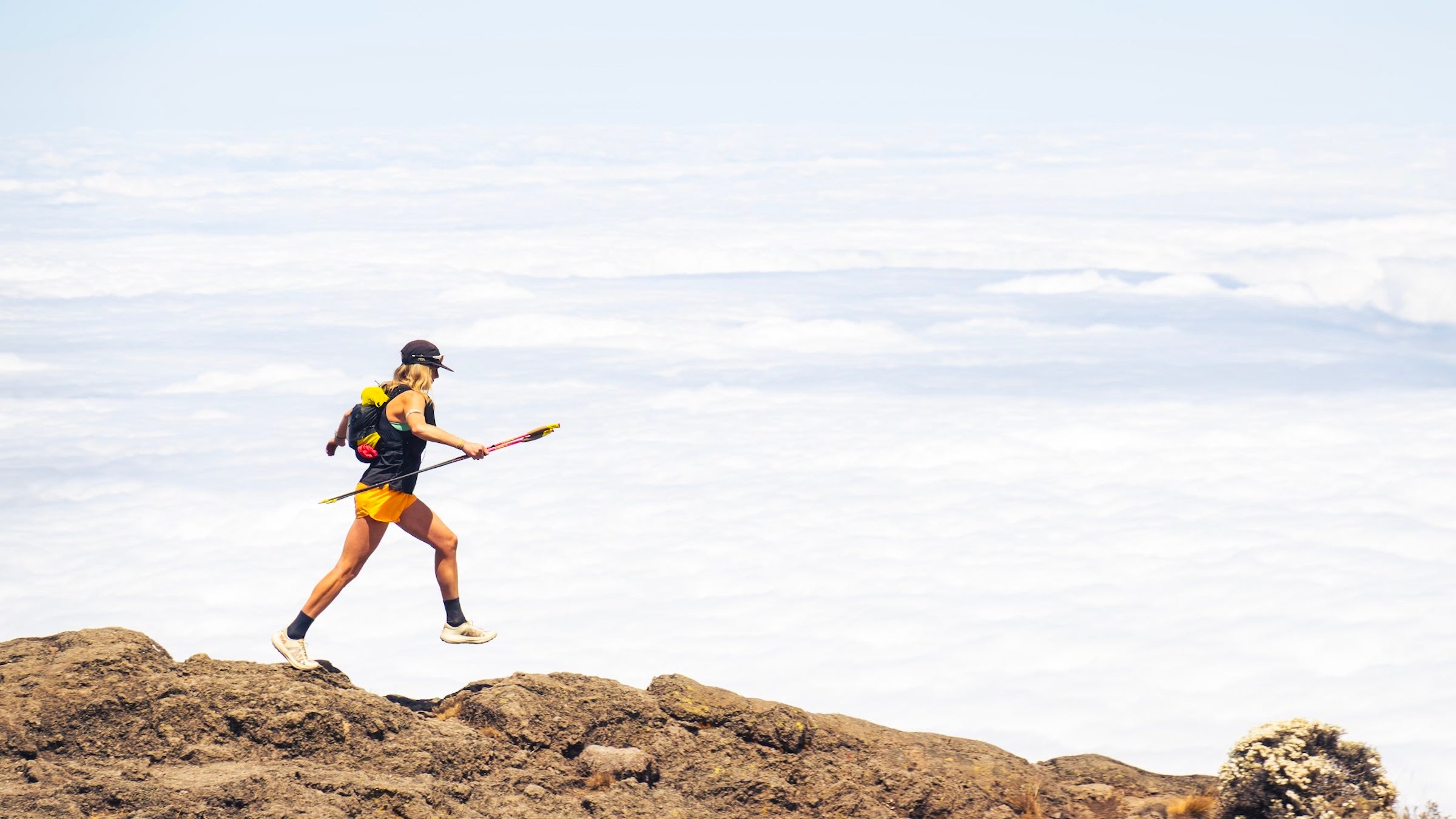
“This was a different climb than, say, Aconcagua, because it was at a much lower elevation, but it had more layers and elements to it,” Ton said. “I would say the alpine terrain was more similar to Colorado than the high alpine peaks in South America or Nepal.”
With Kilimanjaro now successfully checked off, Ton holds speed benchmarks on two of the seven targeted continents. Remaining on her extensive global tick-list are 16,024-foot Carstensz Pyramid in Indonesia, 20,310-foot Denali in Alaska, 18,510-foot Mount Elbrus in Russia, 16,050-foot Mount Vinson in Antarctica, and the towering 29,031-foot summit of Mount Everest in Nepal.
From Monkeys Overhead to Ice Underfoot
To beat the crowds of international tourists who flock to Tanzania’s most famous national park, Ton kicked off her record attempt well before sunrise at Mweka Gate. Following about six miles of winding dirt trail through the dense lower forest canopy, she reached Mweka Camp. However, the initial phase of the run had already taken a physical toll; the thick dust hanging in the air left her with a bloody and irritated nose.
“I probably looked like a madwoman running with blood dripping down my face,” she recalled.
From there, she pushed onward through the thickening air, covering the two-mile stretch to Millennium Camp at an elevation of 12,500 feet. Ton reported feeling remarkably strong through this middle section of the course, maintaining her momentum until she arrived at Barafu Camp, located another six miles up the trail at 15,000 feet. It was at Barafu, deep within the stark alpine desert zone, that she began experiencing the unwelcome onset of altitude sickness. Despite the physical setback, she refused to slow down, gritting her teeth to push through the discomfort.
“Altitude is normally where I excel, and I believe it is where I have my competitive advantage as an athlete,” she said. “This was one of the very few times I can recall feeling poor at altitude. I’ve been reflecting and still don’t have a solid understanding of why I felt that way.”
Battling the effects of the thin air, she powered through the remaining five miles of the route, pressing upward toward Uhuru Peak, the ultimate high point of Mount Kilimanjaro. After reaching the summit, Ton and her two accompanying guides spent a brief moment taking in the accomplishment before immediately turning around to begin the long descent back down the mountain.
Her exceptional pace did not stop at the summit. By completing the roundtrip journey in 8 hours and 33 minutes, Ton secured a second record, eclipsing Fernanda Maciel’s previous roundtrip benchmark of 10 hours and 6 minutes.
What’s Next
Reflecting on her journey, Ton emphasized that the most profound rewards in her life have been forged through perseverance. She expressed a sincere hope that her achievements will serve as motivation for others to step away from their routines and embrace physical challenges in the outdoors.
“I hope my story inspires others to step outside their comfort zone and invite challenge in everyday life,” she said. “All too often, we get caught up in chasing the next big material comfort when it is a big world out there with so many people and cultures to experience.”
Looking ahead to the continuation of her global project, Ton plans to tackle Alaska’s formidable Denali in the spring of 2027, provided that logistical windows do not open up for her to head to Indonesia’s Carstensz Pyramid or Antarctica’s Mount Vinson beforehand.