



NEW ORLEANS — All passengers and crew members have been safely accounted for following a dramatic maritime collision on the Mississippi River in New Orleans on Friday, in what local officials have described as a miraculous escape from a potential catastrophe.
The incident unfolded at approximately 12:30 p.m. local time when the Atlantic Asphalt tanker collided with the American Heritage, a river cruise liner operated by American Cruise Lines. At the time of the crash, the cruise ship was docked outside the Port of New Orleans’ administrative building. The vessel was carrying 129 passengers alongside its regular crew members.
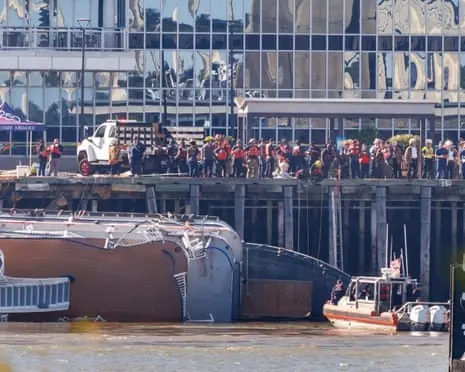
According to eyewitness accounts and dramatic video footage circulating across social media platforms, the impact caused the cruise liner to rapidly list to its side, turning almost completely horizontally toward the open water as it began taking on water. Panic briefly ensued on board as the vessel tilted, forcing terrified passengers to climb onto balcony railings to prevent themselves from sliding directly into the swift-moving river current.
New Orleans Mayor Helena Moreno delivered an encouraging update later in the evening, confirming that every single individual aboard the vessel had been accounted for. Calling the outcome “truly a miracle on the Mississippi,” Moreno noted that the stricken ship had also narrowly missed striking a heavily traveled local bridge that carries approximately 160,000 vehicles across the river daily.

Emergency response teams flooded the area immediately following the crash. Helicopters hovered above the scene to survey the wreckage, while numerous ambulances staged along the dock to receive casualties. Thirty-two people were subsequently transported to local hospitals for medical evaluation and treatment. Among those hospitalized were two dedicated New Orleans Harbor Police officers who courageously plunged into the water to rescue stranded passengers as the ship began to sink.
Major healthcare provider LCMC Health confirmed that its facilities had received approximately two dozen patients in the wake of the maritime disaster. In a statement released to media outlets, the health system noted that University Medical Center New Orleans and other network hospitals were actively evaluating patients, providing appropriate medical care, and coordinating closely with emergency services.
The exact cause of the collision remains under active investigation. Captain Melanie Burnham, commander of the US Coast Guard sector in New Orleans, told reporters during a briefing that preliminary observations pointed toward a mechanical failure. “There seems to be some type of a loss of steering,” Burnham said regarding the tanker, adding that investigators had not yet determined the precise catalyst for the malfunction.
Louisiana Governor Jeff Landry addressed the public during a news conference, confirming that the state would launch a thorough investigation into the incident to ensure safety protocols prevent any future occurrences. Praising the rapid and fearless response of local emergency personnel, Landry remarked that the Mississippi River is “not some quiet pond” and commended first responders who risked their lives to pull survivors from the water.
Congressman Troy Carter, representing Louisiana’s 2nd congressional district, shared his devastation over the accident on social media, stating that he was monitoring the situation closely and praying for a swift recovery for all survivors and responders.

The collision sent immediate shockwaves through the local infrastructure. In response to the emergency, the US Coast Guard issued a statement announcing the closure of the Mississippi River to all vessel traffic between mile markers 93 and 96—the exact stretch where the crash occurred. The temporary closure was implemented to clear the waterway for first responders to assess the structural stability of the area and conduct ongoing recovery operations.
Additionally, the New Orleans Regional Transit Authority announced that ferry services across the Mississippi River had been temporarily suspended as a precautionary safety measure, urging travelers to seek alternate routes while emergency crews worked to clear the channel.
Witnesses on the ground described a scene of absolute surrealism and chaos. Devon Flanagan, an employee working nearby at the port, recalled seeing dockworkers rushing toward the water after hearing the initial impact. Stepping out of his truck, he witnessed the American Heritage lying on its side while passengers struggled in the water. He noted that other commercial vessels and barges in the vicinity quickly rushed to assist, compounding the frantic activity as rescue operations got underway.
Another witness, Jamie Holford, told local broadcaster WDSU-TV that the entire sequence of events transpired with terrifying speed. “Fifteen minutes from impact to where it rolled over,” Holford said.
An anonymous employee at the nearby Convention Center recounted looking out past the brick wall separating the building from the river to see the tilted tip of the cruise ship, followed immediately by desperate cries for help. Alongside her colleagues, she quickly assembled wheelchairs, water, and supplies to aid the incoming survivors.
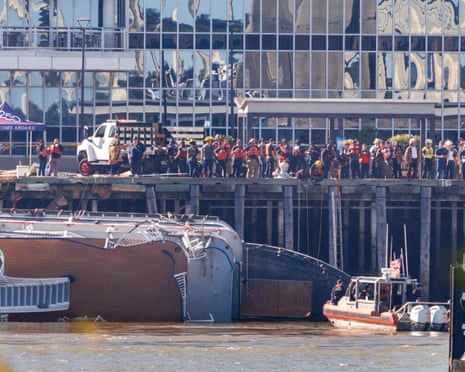
As maritime experts from institutions like Tulane University began evaluating available footage, speculation centered heavily on potential steerage or propulsion failures. Professor Martin J Davies pointed out that because an upbound vessel fighting the strong downstream river current would typically be moving at a slow speed, a failure in the ship’s steering gear or engines would be the most logical explanation for its inability to avoid a stationary vessel docked along the shore. Davies also echoed the mayor’s sentiments regarding the bridge, emphasizing that while the collision was severe, the situation could have been exponentially worse had the tanker drifted into the nearby span.
Federal, state, and local agencies remain on the scene as the investigation continues into Friday afternoon’s events, with authorities working to determine the precise sequence of mechanical failures that led to the near-disaster on the river.