A striking commonality unites some of the most notable breakouts of Swiss cinema in 2026 and the years immediately preceding it: they are either entirely in English or incorporate substantial blocks of English dialogue. This growing trend includes Petra Volpe’s Locarno-winning feature “Frank & Louis,” Damien Hauser’s festival darling “Memory of Princess Mumbi,” Denis Rabaglia’s buzzy project “Butterfly Stroke,” and Tim Fehlbaum’s widely lauded historical thriller “September 5.”
On the very date that titles his award-winning film, Fehlbaum joined fellow acclaimed directors Ursula Meier, who helmed “Quiet Land,” and Michael Koch, director of “Erosion,” at the Venice Production Bridge. With Switzerland serving as the country of focus at the prominent industry event, the trio gathered to discuss this unfolding cinematic phenomenon during a panel titled “Beyond Borders: English as the New Language in Swiss Cinema?” Moderated by Variety Italy and Middle East Correspondent and Rome Bureau Chief Nick Vivarelli, the engaging discussion homed in on the complex landscape of benefits and challenges that come with shooting in English for Swiss filmmakers today.
During the panel, Fehlbaum offered a glimpse into his upcoming slate, revealing that his next project will take place in Berlin and be shot in a bilingual mix of German and English. Explaining the creative and practical mechanics behind the choice, he noted that the story is set in historical Germany but benefits from incorporating an American perspective.
“It’s always a question of how much will be in German and how much will be in English,” Fehlbaum explained to the audience. “By changing one character to a person who doesn’t understand German, you suddenly have much more English, and it’s much easier to finance.”
Expanding Horizons and International Appeal
Ursula Meier shared her current experience producing “Quiet Land,” which featured prominently in this year’s Venice Gap-Financing Market. The upcoming English-language film is set to star Hollywood heavyweights Bill Murray and Léa Seydoux. With a narrative anchored in the American state of Montana, production is slated to take place in Alberta, Canada. As she prepares for pre-production ahead of a shoot next year, Meier reflected on what drew her to the project and the language choice.
“For me, it’s interesting for my work to tell a bigger story, and everything in the U.S. is bigger,” she said when asked about her reasons for directing in English.
Transitioning to a foreign language also proved to be a formidable professional hurdle. “It was a great challenge for me,” the writer-director admitted regarding the screenwriting process. Noting that her personal fluency in English has its limits, she explained that she spent a dedicated year working on the text. “We wrote the script in French, and then it was translated. We followed the translation process very closely.”
Meier also expressed a profound appreciation for working with American performers, drawing comparisons to her experience with Gillian Anderson on the Oscar-shortlisted drama “Sisters.” Working with Anderson left a lasting impression on the director, who praised the physical nature of American acting styles. “It was so great to work with her,” Meier recalled. “I like how American actors embody characters. It’s very physical.”
Michael Koch has likewise stepped into the realm of international casting, having recently wrapped production on “Erosion” with acclaimed American lead Peter Sarsgaard. The new drama reunites Koch with the non-professional actors from his previous feature, “A Piece of Sky.” The narrative observes the intricate social dynamics that unfold between a foreigner and local Swiss farmers in a tight-knit mountain village. Notably, it was Fehlbaum who originally facilitated the creative bridge between Koch and Sarsgaard following their successful collaboration on “September 5.”
For Koch, employing an English-speaking star was an intentional artistic decision from the outset. “It was, in a sense, the concept of the film, also,” the director emphasized. Unlike his previous film, which relied entirely on non-professional actors and examined a specific mountain world from the inside, Koch wanted to invert the perspective this time around.
“I wanted this time to turn it around and look with the eyes of a stranger to this world,” Koch said. “It was clear from the beginning that it had to be the eyes of a foreigner. The second thing that intrigued me a lot was to put a famous actor like Peter together with non-professional actors from the Swiss mountains, which sounds like a really weird combination, but it was something I wanted to explore.”
Despite embracing the linguistic shift, Koch pushed back against the notion that English is inherently the new definitive language of Swiss cinema, preferring to frame it as simply “a part of it.” Navigating a different language proved to be a fascinating interpersonal experiment on set, particularly when verbal communication was limited and forced alternative creative interactions to emerge. “This was the interesting thing to observe: how people from different worlds come together and share something beyond verbal communication,” he noted.

The Financial Realities of International Casting
Securing a major American actor as a lead also transformed the financing mechanics for Koch’s production. Picking up on Nick Vivarelli’s Ferrari metaphor during the panel discussion, Koch described the funding process as operating at a higher gear.
“It’s a bit more money you have to get, but it’s also easier,” Koch observed. “It went quite fast, I have to say. It was also possible because [Sarsgaard] really wanted to make the film, otherwise, we couldn’t afford it.”
Reflecting on his own career trajectory, Fehlbaum offered a cautionary perspective on language selection, arguing that linguistic choices must always serve the narrative architecture of a film rather than serving as mere commercial calculations. He recalled that during the development of his feature directorial debut, the post-apocalyptic sci-fi thriller “Hell,” producers insisted that he shoot the project in English.
“It was before Netflix, and people told me I couldn’t get it financed,” Fehlbaum said. Trusting his instincts, the director decided the English language did not suit the diegetic reality of the story. The ultimate success of the film both domestically and internationally proved his creative conviction right.
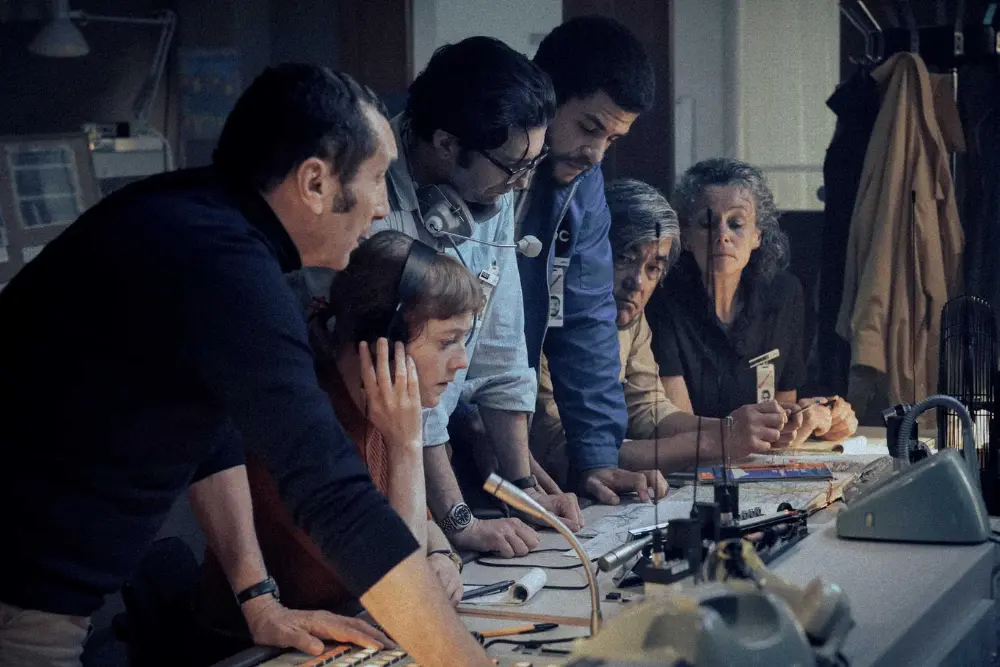
However, for his subsequent follow-up, “The Colony,” Fehlbaum chose to shoot in English even though the script did not strictly demand it. The lukewarm critical and commercial response to that project reinforced his core thesis: a film should only be made in English if that choice makes sense within the logic of the story. That realization directly informed “September 5,” which naturally unfolded from the authentic perspective of American television broadcasters trapped in Munich during the hostage crisis at the 1972 Olympic Games.
Linguistic Subtext and the Dangers of Automation
Beyond financial viability and narrative logic, Fehlbaum highlighted structural differences between languages that can genuinely aid screenwriters. As a native German speaker, he noted that the English language offers a substantially broader vocabulary.
“The English language, compared to German, has three times as many words,” Fehlbaum pointed out. “In scriptwriting, you always want scripts to be short. In English, it’s cool that you can use just one word when in German you’d have to write a whole sentence. For subtext, English is better. In German, words are very specific.”
Yet, even as writers grapple with linguistic nuances across borders, Fehlbaum issued a stern warning against the growing temptation to rely on artificial intelligence for script translation. Recalling a conversation with a professional translator who warned that AI automation is beginning to infiltrate positions previously held by human experts—such as translating scripts and dialogue on set—Fehlbaum championed the indispensable value of human collaboration. He pointed to his rewarding experience working with a seasoned linguist during the making of “September 5.”
“We first wrote the script in German and it was clear that we would get a translator on board,” Fehlbaum said. “He not only translated the script but had a different perspective and made it much more American. It’s important to get authenticity.”
Among the practical hurdles discussed by the panelists, all three directors acknowledged the distinct pressures of communicating in a secondary language with cast and crew while managing the intense daily demands of a film set. “I realized the language barrier is much bigger than I would’ve thought,” Fehlbaum admitted.
Offering an optimistic counterpoint, Koch noted that this very barrier could sometimes foster deeper artistic engagement. “There’s also a nice thing about that,” Koch added. “Because then actors are really challenged to think about: what does he mean? So they start to participate in this process also.”
Ultimately, the panelists observed that Switzerland itself is a nation inherently constructed around linguistic diversity, recognizing four official languages: German, French, Italian, and Romansh. Within that unique domestic framework, the filmmakers agreed that while English-language productions are undoubtedly on the rise, foreign tongues represent just one more versatile tool available to contemporary Swiss directors as they continue to share their stories with the world.