At some point in most women’s lives, a familiar line of thinking creeps in—whether arising on its own or planted by well-meaning parents, relatives, and cultural conditioning: What if I don’t get married? What if I never find my person and end up alone?
For Joan, that panic hit in her 30s with enough intensity to land her in a psychologist’s office. Back then, she recalls, a woman who didn’t want a husband was frequently assumed to have something fundamentally wrong with her. But her therapist—who was married with children yet remarkably more open-minded than most during that era—didn’t try to correct her with cheesy motivational mantras or fear tactics about a ticking biological clock. Instead, she asked a probing question: What kind of husband would you want, if you had one?
Joan listed a few traits. Someone busy, she recalls saying. Someone deeply absorbed in his own life—his job, his hobbies, his community.
“So you’d want someone intellectually stimulating?” her therapist asked.
“No,” Joan replied. “I’d want someone who’s never home.”
It landed as a joke in the room, though deep down, it wasn’t entirely a joke. What emerged from that therapy session was an almost accidental realization that sounded radical at the time, around 1980: Some people genuinely live their best lives independently. Now 79, single, and entirely uninterested in changing her relationship status, Joan has spent decades proving her theory true through a life rich with autonomy.
How the Single Life Became Aspirational
For much of modern history, women like Joan were cast as anomalies, social outcasts, or cautionary tales. Society has long relied on tired archetypes: the childless cat lady, the old maid, the lonely spinster. Singlehood was traditionally framed as a transitional phase, a temporary pit stop on the highway to finding "the One." It was rarely viewed as an end goal in itself, and certainly never as a deeply fulfilling or complete way to live.
Yet, cultural tides are shifting. The older, unmarried women of this generation are living proof that a life constructed without a husband isn’t a fallback plan or a consolation prize; it is a deeply satisfying, deliberate choice.
You can witness this cultural evolution in the collective fatigue surrounding modern dating. According to a recent Forbes Health survey, an overwhelming 78% of users on popular dating apps—including Tinder, Hinge, and Bumble—reported feeling burnt out by the modern dating landscape. Meanwhile, young adults in their mid-20s to early 30s, demographic groups traditionally considered to be in their "prime marriage years," are having far less sex than previous generations. Data indicates that sexual inactivity has risen by roughly 50% for women over the past decade.
This sociological shift is mirrored clearly in popular culture as well. There is a growing appetite in entertainment for storylines that consciously sideline traditional romance in favor of deep friendships, personal independence, and chosen families, as seen in cultural touchstones like the films Barbie and Wicked.
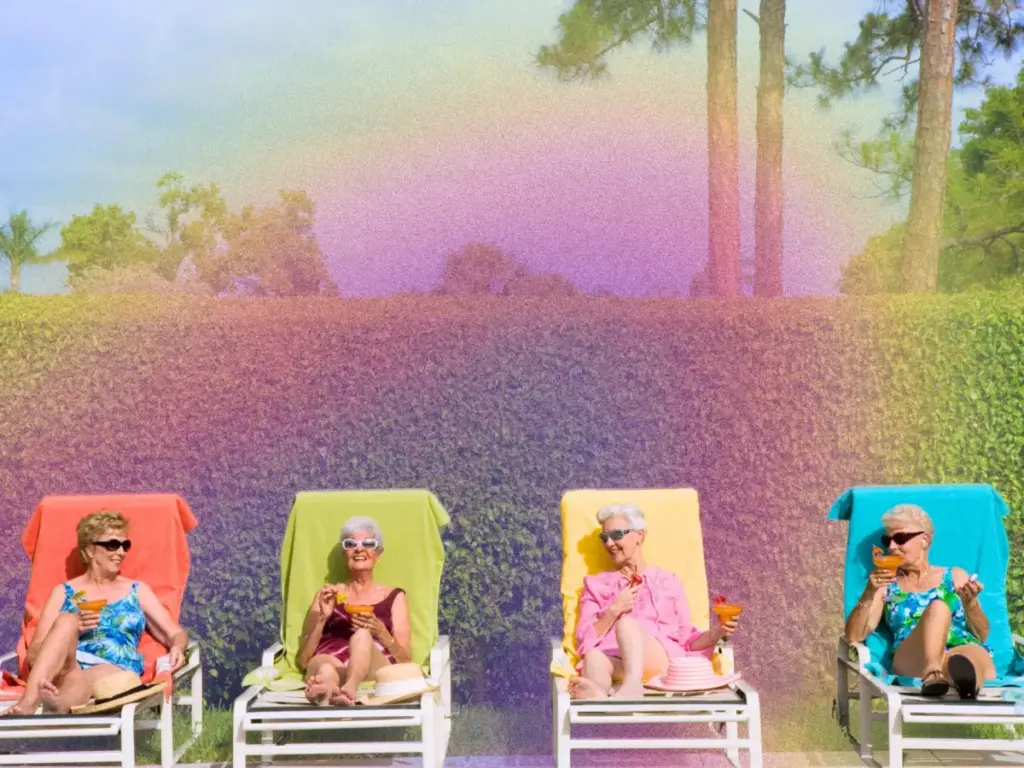
Perhaps the clearest proof, however, lies in the lived experiences of real people. Several women in their 70s and 80s who have been single for decades report no lingering wishes that they had done things differently. If anything, their lives carry an unmistakable sense of ease and expansiveness. Many describe weekly, laughter-filled gatherings with friends, impromptu solo travel planned on a whim, and the financial freedom to buy property, adopt pets, start small businesses, or simply do whatever they want, whenever they want.
A few still engage in casual dating, dipping in and out of flings only when it strictly suits their desires. Others have opted out of romance entirely. As one 73-year-old woman bluntly puts it, her favorite part of the lifestyle is simply "not having to bicker or put up with an incompetent man." She adds that this autonomy is likely why she feels the least stressed she ever has in her life.
Across these women’s stories, there is no lingering regret or sense of missing out. They are simply older women enjoying where they are, bearing little resemblance to the bitter man-hater or the desperate, unlucky romantic caricatures historically pushed by media and society.
"Now, Women Are Looking for Something Additive"
As Joan points out, not everyone starts off wanting a romantic relationship and then moves on to singlehood as a reluctant Plan B. This perspective has become increasingly common in sociological research, inspiring frameworks like the one built by sociologist Bella DePaulo, PhD. In her book Single at Heart, Dr. DePaulo explores the lives of individuals—including herself—who do not merely end up alone by circumstance, but genuinely orient toward singlehood as an authentic personal preference.
Reflecting on her own youth, Dr. DePaulo, now 72, notes that while she looks back fondly on the men she dated when she was younger, she remembers an even stronger, more positive feeling when each of those relationships came to an end: a profound sense of finally being free.
The practical benefits of singledom—solitude, robust friendships, and the absence of everyday relational stressors—are not strictly exclusive to unmarried individuals. However, Dr. DePaulo argues that couples are rarely free in the way single people are. The primary difference is psychological: the unique ability to structure a day, a life, or even a passing thought without reflexively factoring in another person’s needs, moods, or reactions.
A romantic partner is often present in a person’s mind almost constantly, even if only on the periphery. While that constant companionship can be comforting for many, Dr. DePaulo notes it can also feel unwelcome, as though an individual is perpetually managing what their significant other might want or feel. By removing that mental calculus, an individual’s attention and energy become entirely their own.
Of course, the absolute ability to choose this lifestyle is a relatively recent historical development. For centuries, marriage was far more than a matter of romance; women relied heavily on matrimony for basic financial stability, social acceptance, and a socially sanctioned path to building a family. Kris Marsh, PhD, a sociologist and author of The Love Jones Cohort: Single and Living Alone in the Black Middle Class, emphasizes that historical dependency shaped generations of women.
However, with greater access to education, expanding career opportunities, and true economic independence—paired with broader, modern definitions of intimacy, family, and personal fulfillment—the societal pressure to couple up has steadily eased. Data from the Pew Research Center indicates that 42% of U.S. adults were unpartnered in 2023, up significantly from 29% in 1990. Furthermore, among non-dating adults younger than 50, half express no interest in pursuing a relationship at all, though embracing singlehood does not inherently require holding an anti-love attitude.
As Dr. Marsh observes, many contemporary women are looking for a partnership that is strictly additive. They often express that they are already in a very good place on their own, meaning any prospective partner cannot be a distraction or a disruption to their hard-won peace. For most, however, that realization does not happen overnight.
Alice Foster, who recently celebrated her 80th birthday, followed the traditional cultural script handed down to many women of her generation: she married young, raised children, and maintained domestic stability. Yet, looking back, she recalls feeling that the arrangement was never truly about her. It did not feel like her own life.
When her marriage ended in divorce in 1988, what followed was not the profound loss she had been conditioned to fear. Instead, it brought space, peace, and an opportunity for personal recalibration. She moved upstate, returned to school, and built a new career in nursing, slowly constructing a daily routine that finally felt authentic.
Now, reflecting on her retirement, Foster expresses immense joy in her independence. She loves traveling, hosting visitors, and answering to no one. Having been single for decades and deeply satisfied with that reality, she has no desire to become tied down. Experts note that this trajectory is remarkably common.
Rather than functioning as a rigid moral stance or a lifelong rejection of romance, singlehood frequently manifests as a lived, flexible experience. It often develops as a gradual acceptance of self-reliance that an individual might not even realize they are choosing until years later. Perhaps, like Foster, someone leaves an unsatisfying marriage, pulls back from exhaustive online dating, or decides to dedicate a year entirely to career progression, personal hobbies, or travel. Over time, they stop planning their existence around the hypothetical arrival of a relationship—and realize they already possess the joy and security they once believed only a husband could provide.
The Unexpected Joy of Your Own Company
Even with cultural shifts, a persistent question tends to linger in public discourse: Are these women actually happy?
Recent research suggests an emphatic yes. In fact, satisfaction with singlehood tends to increase steadily with age, often becoming most pronounced for individuals in their 40s and beyond. Despite broader cultural progress, a lingering skepticism remains regarding why anyone would willingly choose to remain single. While married individuals are typically taken at their word when they claim fulfillment—even when reality proves more complex—those who deviate from the marital norm face continuous public scrutiny.
Dr. Marsh notes that single individuals must often be exceptionally confident and resilient to stand comfortably in their singleness and validate to a skeptical world that they are genuinely thriving. This societal expectation frequently flattens older single women into rigid caricatures—either hyper-independent success stories or pitiable failures—leaving little room for the nuance of real human experience.
Yet, that external pressure can ultimately have an unintended, liberating effect. After decades of being nudged by society to justify their lifestyle choices, many older single women simply stop performing. The women interviewed for this article offered no overexplanations, showed no defensiveness, and displayed little interest in winning over skeptics.
They simply live.
It requires a distinct kind of internal confidence and clarity to stop shaping one’s life around historical expectations and instead follow what feels genuinely fulfilling, without apology. What emerges from that choice is a quieter, rarer form of happiness—one that is not performed for an audience and does not depend on external validation. Instead, it feels fundamentally authentic, and it endures.