


Nothing about where interior designer Harrison Soll finds himself today was part of the original blueprint. Five years ago, Soll was entirely consumed by his burgeoning design work, intentionally keeping his head down and avoiding personal distractions. But life intervened in the autumn when he crossed paths with Rodney Burns, a visionary stylist and the owner of Church Boutique, the legendary Los Angeles vintage gallery. That chance meeting set both men on an entirely unexpected and creatively charged path. By New Year’s Day, they were a couple.
Reflecting on how quickly their lives intertwined, Soll admits he initially did not expect a lasting romance to blossom from their introduction. Instead, he credits their deeply shared passions as the ultimate catalyst that brought them together. "We always found a throughline with design," Soll explains, highlighting a foundational aesthetic harmony that would eventually spill over from their professional lives into a shared domestic sanctuary.

Today, the couple resides in a picturesque 1925 Craftsman house nestled in the historic and bohemian enclave of Laurel Canyon. Soll took the creative lead in decorating the roughly 1,400-square-foot home, blending their distinct sensibilities into a singular visual language. Many of the furnishings, pieces of vintage art, and striking sculptures scattered throughout the rooms were pulled directly from Burns’s eclectic, hard-earned personal collection.
Burns is well-known in the creative world, having spent the past 15 years working closely alongside legendary musician Lenny Kravitz as a stylist and creative collaborator. Kravitz, who has watched the couple’s creative partnership evolve, holds a deep appreciation for the environment they have cultivated together in the canyon. "The mix of Rodney’s early- to midcentury style mixed with ethnic expression next to Harrison’s bold minimalist modern approach seamlessly blend together," Kravitz tells Architectural Digest.

Merging two fundamentally opposing design philosophies under one roof was no small feat, particularly given their contrasting personalities. Soll describes his own taste as leaning toward clean, bold minimalism, while Burns proudly avows that he operates as "a maximalist to the umpteenth power." Despite these differences, the pair managed to strike a delicate and dynamic balance, filling every corner of the Craftsman house with rich character and narrative.
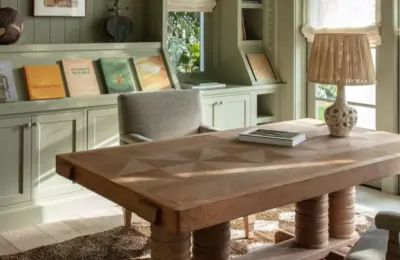
Some rooms lean heavily into Soll’s restrained inclinations, such as a dedicated home office featuring a streamlined midcentury desk anchored by a striking 1970s vintage textile art piece. Soll recalls admiring the tapestry from the very beginning of their relationship, admitting that when he used to visit Burns’s apartment, he would worry to himself, "Oh my God! Like, if we break up, I’m never gonna be able to find this tapestry."

Similarly, the dining room showcases a refined spatial arrangement where a Sergio Bustamante table rests on a deliberate diagonal. Soll explains that the unusual angle was a practical necessity to accommodate the couple’s large dog—though he jokingly blames the furniture’s dimensions rather than the canine, noting, "She’s a girthy girl," while gesturing to the table. Surrounded by chairs designed by Paul Evans, a Chinese Art Deco rug sourced from Ariana Rugs, and a Tom Greene chandelier pulled straight from Burns’s boutique, the dining space exemplifies their successful synthesis of eras.
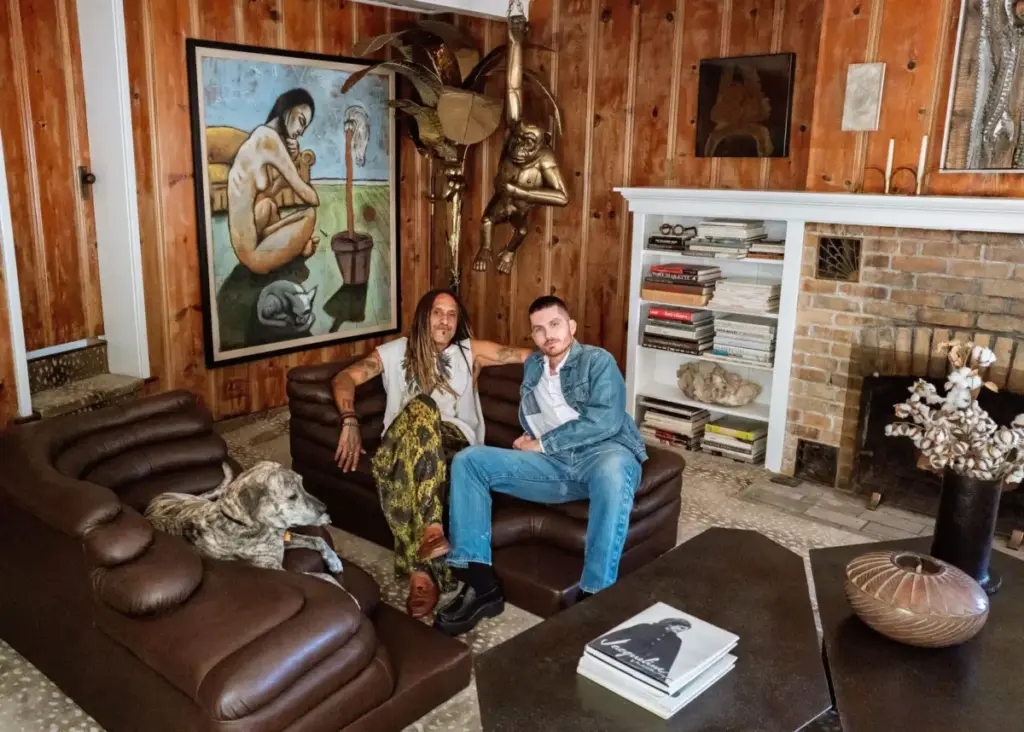
By contrast, Burns’s maximalism takes center stage in the living room, a visually dense space where a couch upholstered in leopard-print Scalamandré fabric sits alongside zebra-hide chairs and a sinuous, sculptural leather De Sede Terrazza sofa. To prevent the space from becoming overwhelmingly busy, Soll exercised a bit of editorial restraint. The leopard-print couch deliberately incorporates a solid block of leather upholstery, with Soll pointing out, "I just think it would have been too maximalist to do a full Scalamandré sofa."

The living room further serves as a cabinet of curiosities, filled with an array of brass sculptures, including a Maison Jansen palm tree and a Sergio Bustamante monkey, alongside bronze figures sourced from an estate sale in Arizona and various other pieces of avant-garde sculptural artwork. Above the living room fireplace hangs a piece of nail art with a particularly charming backstory. Burns and Soll had originally spotted the piece at a Santa Monica vintage shop, but Burns hesitated and regretted not purchasing it immediately. When he returned to the shop to finally buy it, the piece was marked as sold—unbeknownst to him, Soll had already covertly purchased it as a thoughtful Valentine’s Day gift.
The foyer presented another unique challenge, acting as a battleground for their competing aesthetic impulses. The entryway features a collection of traditional masks and vintage paintings, an area Burns found notoriously difficult to style. Overwhelmed by his own massive collection of artifacts, Burns at one point suggested putting all of his masks into storage for a future home or passing them along to Church Boutique. Soll immediately dissented, offering a simple counter-mandate: "No, let’s put them everywhere."

The foyer also houses a giant Sergio Bustamante giraffe bust, which remains a gently contested topic between the couple. "The giraffe was one of our biggest fights in decorating this house," Burns explains, defending its presence. "I was determined to have that giraffe live some place in this house because he’s just fantastic, and the scale of him, and the rarity of him." Soll, however, points out the logistical hazard of the placement, noting that the front door swings directly into the sculpture’s path. "You just have to be careful," Soll remarks with a shrug.
As renters, the couple naturally faced structural limitations regarding what could be achieved within the historic home. However, Soll managed to secure permission from their landladies to retile a bathroom and install a new vanity, accessorizing the space with a metal Curtis Jere artwork from Burns’s collection. In the living room, the installation of doe-patterned wall-to-wall carpeting was an impulsive "ask for forgiveness" move by Soll. While the landladies ultimately ended up loving the bold flooring choice, Burns required significantly more persuasion. "The carpet took many dinners of conversations between the two of us," Soll recalls.

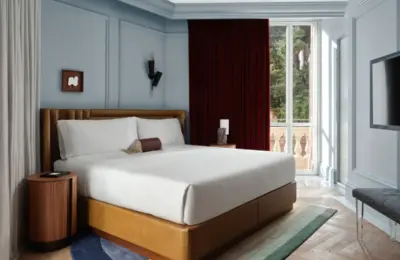
The bohemian architecture of the Laurel Canyon home naturally lends a distinct quirkiness to the interior layout. The main bedroom, for instance, is not a perfect square, creating the optical illusion that a sleek stainless steel bed from TTMM has been placed on a diagonal, when it is actually just conforming to the home’s unconventional, angular geometry. The bedroom successfully mixes heavy patterns and textures, featuring Paul Evans "Cityscape" nightstands, striped bedding, and antique bronze table lamps topped with custom African mud-cloth shades. Outside, the backyard features funky, inherited stonework and vintage pottery, alongside a backyard shed that cleverly doubles as Burns’s outdoor closet.
Reflecting on the collaborative design process, Burns notes that Soll has profoundly influenced his approach to collecting. "He has made me be able to take a pause and then also make me a little less attached to some of the things that I’ve collected and given me an opportunity to maybe show a little bit more restraint," Burns says. Comparing home design to personal styling—a field he has dominated for over a decade while dressing Lenny Kravitz—Burns insists the two disciplines are fundamentally identical: "Building an outfit, building a room: same thing in my opinion."

Kravitz offers high praise for his longtime collaborator’s unique artistic vision. "What I love about Rodney is that he is limitless in his concepts and always thinks outside of the box," Kravitz notes. "His visual vocabulary enables him to mix a vast stew of eras and genres. He pays tribute to our ancestors and uplifts new innovators. Always soulful, expressive, and elegant."
Ultimately, the home reflects a harmonious collision of two distinct creative minds. Soll describes the overarching atmosphere of the house as possessing an Afrocentric theme infused with a distinct touch of traditional Ralph Lauren sensibility. "Our visions have mingled," Burns summarizes. With the interior design nearly complete, the couple faces just one final, minor domestic hurdle remaining in their shared journey: finding a blanket basket. But, as Soll laughs, "We still haven’t found one we agree upon."