A natural, beneficial bacterial probiotic is offering a renewed sense of hope in the ongoing, high-stakes battle to mitigate the rapid and devastating spread of disease in coral reefs off the coast of Florida. In a newly published scientific study, researchers have closely investigated the real-world effectiveness of a specific bioactive compound produced by the probiotic strain MCH1-7. Their findings suggest that this microbial treatment could play a crucial role in combating stony coral tissue loss disease, an aggressive and frequently fatal affliction that has severely impacted marine ecosystems throughout the region.
The bacterial strain MCH1-7 was originally discovered back in 2018 by marine scientists working at the Smithsonian Marine Station. Researchers first identified the beneficial microbe living on a wild coral colony that had successfully and naturally resisted a severe local outbreak of stony coral tissue loss disease, commonly referred to as SCTLD. Recognizing the potential implications of this natural resilience, marine biologists began exploring whether the protective mechanisms of this specific strain could be harnessed, replicated, and applied to other vulnerable corals facing imminent exposure to the deadly syndrome.
While previous scientific trials and laboratory experiments have tested the bacterial probiotic primarily on mature adult corals, researchers have now significantly expanded their scope. A newly published study featured in the academic journal Frontiers in Marine Science details how this same probiotic compound could be effectively utilized to limit disease transmission and progression. Specifically, the scientific team is investigating a natural compound known as tetrabromopyrrole, or TBP, which is autonomously produced by the MCH1-7 bacteria. They are working to understand the exact biochemical mechanisms through which TBP may act as a shield, protecting entire coral colonies from succumbing to the relentless tissue loss characteristic of SCTLD.
To better understand the ecological context of this compound, researchers point to its broader role in marine biology. Jennifer Sneed, a prominent marine biologist at the Smithsonian Marine Station, explained the broader natural implications of the compound in an official institutional statement. She noted that if TBP serves as a natural settlement cue for coral larvae, and if the bacteria that naturally produce this same compound also confer disease protection to the corals, it creates a logical evolutionary alignment. In short, coral larvae would naturally gravitate toward and settle in areas where those protective compounds are already being actively produced. As a result, a higher percentage of those young corals would survive long enough to recognize and benefit from the compound’s protective properties.
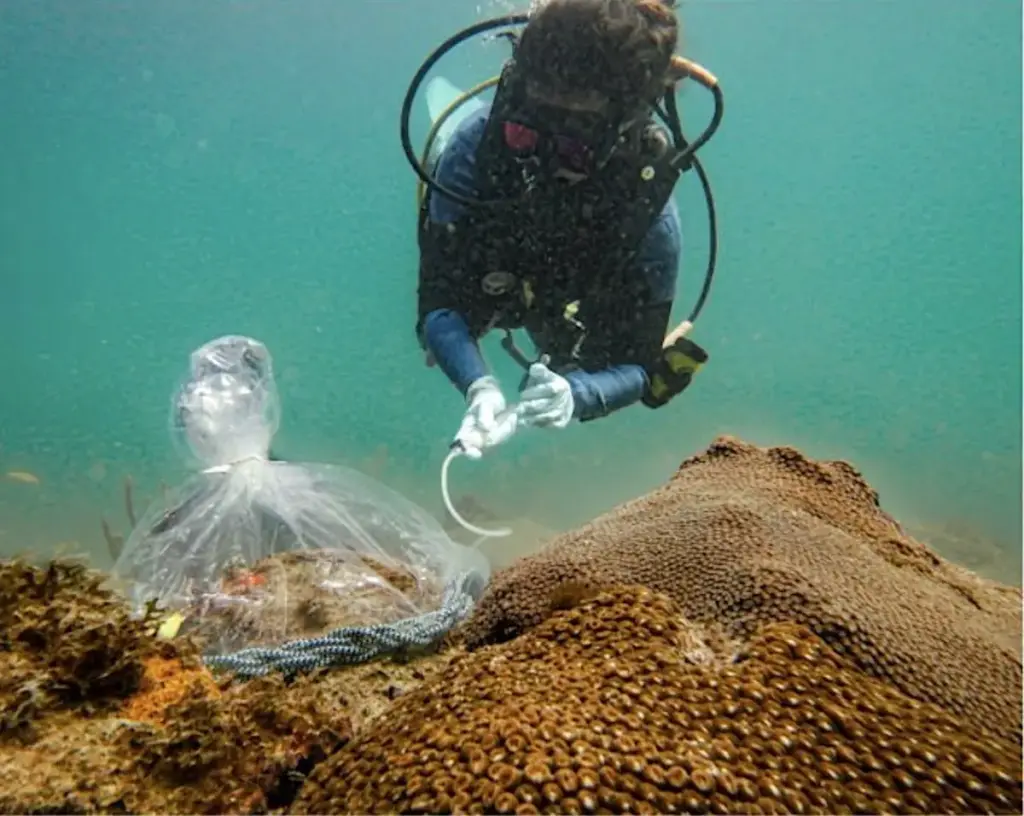
In order to rigorously test the real-world efficacy of the compound against active disease threats, researchers applied the MCH1-7 probiotic to great star coral colonies, scientifically known as Montastraea cavernosa, utilizing two distinct experimental methodologies. The first method involved injecting the liquid probiotic directly into a concentrated volume of seawater contained within a weighted, specially designed bag placed carefully around the target coral. This innovative whole-colony bagging technique allowed the research team to evaluate whether treating the entire surrounding aquatic microenvironment could successfully halt or slow down the progression of the disease across an entire coral structure.
The second methodology tested by the team involved a more targeted approach: a specialized medicinal paste containing the probiotic applied directly onto individual disease-related lesions visible on the surface of the coral. Following these initial applications, the scientific team maintained a rigorous monitoring protocol. They continuously tracked the health status of the treated corals and routinely collected and tested coral tissue samples over an extended monitoring period lasting two and a half years following the initial treatment phase.

The long-term data gathered from the multi-year monitoring period revealed significant and promising differences between the application methods. According to reporting by Mongabay News, the great star coral colonies that underwent the whole-colony bagging treatment experienced a remarkably low tissue loss rate, shedding only about 7% of their living tissue as a result of the disease. In stark contrast, untreated control corals monitored concurrently lost an average of 35% of their total tissue to stony coral tissue loss disease over the same timeframe. Furthermore, these protective results were not fleeting; the positive impacts of the whole-colony probiotic treatment continued to actively slow the spread and severity of the disease for the full 2.5 years of post-treatment observation.
Despite the notable success of the whole-colony bagging approach, the localized paste application tested by the researchers did not yield comparable results. The direct paste method proved to be significantly less effective at halting the systemic advance of the disease across the coral structures, leading the scientific team to pivot their focus toward refining the whole-colony technique for field operations.
Building on these insights, the researchers successfully engineered a practical protocol enabling professional scuba divers to carry out the whole-colony probiotic treatments directly in the marine environment. Crucially, the team confirmed through their field evaluations that this underwater deployment method would not adversely disrupt or negatively impact other healthy, co-existing Caribbean coral species in the surrounding ecosystem. This safety verification marks a vital step toward developing a reliable, ecologically sound treatment protocol for full coral colonies facing SCTLD threats in future restoration efforts.
Reflecting on the operational trade-offs involved in scaling up the intervention, the authors of the study acknowledged the logistical demands of the technique in their published findings. They noted that while the whole-colony bagging method inherently involves a higher volume of material transport by scientific divers, as well as significantly more time dedicated to the physical deployment and subsequent retrieval of the bagging equipment, the overwhelming performance advantages far outweigh these logistical hurdles. Specifically, its proven capability to effectively treat stony coral tissue loss disease and actively promote long-term disease resistance led the authors to formally recommend the whole-colony bagging method as the superior application strategy among those tested for probiotic treatments like the MCH1-7 bacterial strain.
At the same time, the researchers and study authors emphasized that a considerable amount of additional scientific research remains necessary before this experimental method can transition into a widely available, routine restoration tool. They noted that future studies must be undertaken to explore and uncover additional prospective treatments capable of addressing the wide variety of other vulnerable coral species that are currently threatened or actively affected by the deadly stony coral tissue loss disease.
Kelly Pitts, the lead author of the newly published study and a dedicated researcher at the Smithsonian Marine Station, underscored the preliminary nature of the findings in an interview with Mongabay News. She stressed that it is crucial for the scientific community and the public alike to understand that this research represents only the very beginning of a long-term scientific journey. While the results are undeniably encouraging for marine conservationists, Pitts cautioned that the treatment is definitively not a comprehensive cure-all for the widespread ecological crisis facing reefs, though she affirmed that the scientific community is undeniably moving in the right direction.