

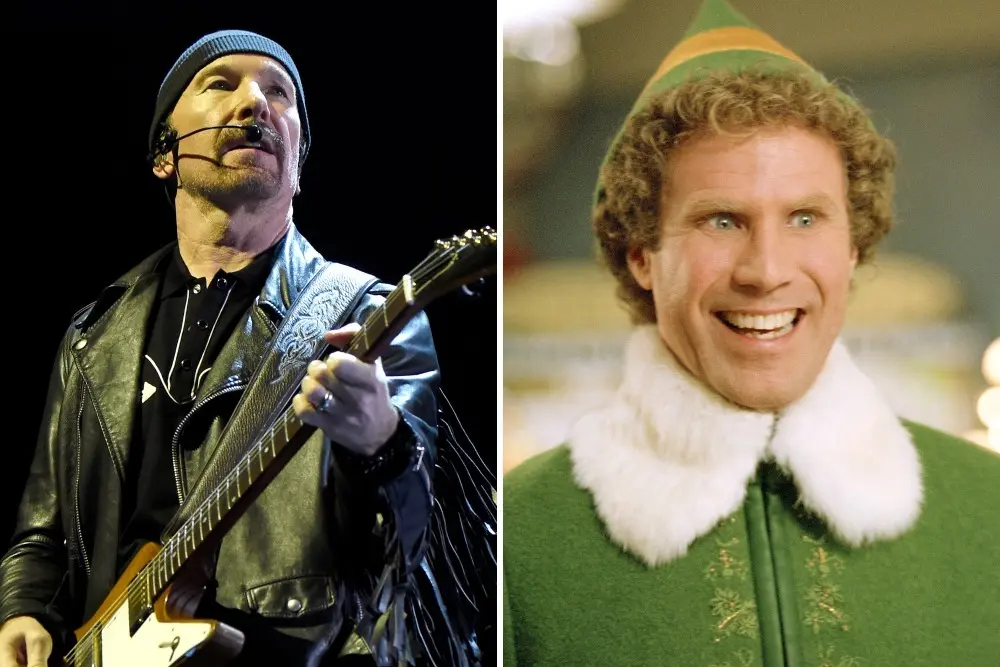
More than two decades after its initial release, Jon Favreau’s 2003 holiday classic Elf continues to occupy a cherished place in pop culture, beloved by generations of moviegoers who embrace its heartwarming comedy every December. However, according to actor and author Andy Richter, the beloved Christmas film very nearly spawned a continuation—including a surprising, fully realized sequel script penned by none other than David Howell Evans, better known as The Edge, the iconic lead guitarist of the legendary rock band U2.
Speaking on a recent episode of Obsessed: The Podcast, Richter shared the bizarre and largely unknown Hollywood anecdote. He explained that Shauna Robertson, who served as a producer on the original motion picture, was once contacted with an astonishing proposal: the famed rock musician had written a complete script for Elf 2 and was eager to discuss bringing it to the big screen.
“Somebody reached out to her and said, ‘The Edge from U2 has written a sequel to Elf, and he wants to talk to you about it,’” Richter recalled during the podcast appearance. Describing the situation as one of the most unusual stories in his industry experience, Richter noted that the screenplay was reportedly fully written. Somewhere in the world, an Edge-penned continuation of Buddy the Elf’s adventures exists in script form, though it ultimately never advanced past initial overtures.
Richter admitted that he would personally love for the mysterious manuscript to eventually see the light of day, but emphasized that the project quickly fizzled out. According to Richter, Robertson initially approached the pitch with standard industry caution, thinking, “All right, sure, I’ll meet him,” only for the concept to quietly peter out and fade away without ever entering active development.
The revelation about U2’s guitarist is not the only untold creative detour in the history of Elf 2. Richter also revealed that Scot Armstrong—a seasoned screenwriter whose credits include comedies like Old School and The Hangover Part II—penned an entirely separate sequel script for the franchise. Armstrong’s version took the narrative in a markedly different and more dramatic direction, focusing on a storyline where “the evil South Pole elves kidnapping Santa or something like that.” Richter also noted that Armstrong had actually contributed to the writing process of the original Elf film, though he ultimately went uncredited due to guild regulations and procedural technicalities within the Writers Guild of America.
Despite the existence of multiple sequel concepts, Richter remains steadfast in his conviction that a follow-up to the 2003 hit is fundamentally unnecessary. As a participant in the original film—where he made a brief appearance as one of the colleagues of Walter Hobbs—and as someone who has deeply engaged with the movie’s legacy, Richter is firmly on the side of preserving the standalone nature of the modern classic.
“I’m on the side of ‘Let it stand,’” Richter stated during his podcast interview. “Just let Elf be Elf. You don’t have to use every part of the animal.”
Elaborating on his perspective, Richter pointed out that the passage of time has only elevated the film’s status, transforming it into something uniquely treasured by audiences worldwide. Because the movie holds such a distinct and spotless reputation, he believes contemporary audiences and creators are rightfully hesitant to tamper with its legacy. Noting that film history is littered with examples of cherished originals whose reputations were tarnished or complicated by late-arriving sequels, Richter posed a rhetorical question that many fans likely share: when a movie is so special, perfect, and beloved, why risk damaging it?
Elf, directed by Jon Favreau from a screenplay eventually credited to David Berenbaum, originally arrived in theaters in November 2003. The film became an instant critical and commercial success, anchored by Will Ferrell’s unforgettable, high-energy performance as Buddy, a human raised by Santa’s elves at the North Pole who discovers his true heritage and travels to New York City to find his cynical biological father, Walter Hobbs, played by the late James Caan. The starry ensemble cast also featured Zooey Deschanel, Mary Steenburgen, Edward Asner, Bob Newhart, and Daniel Tay, creating an ensemble that captured both the whimsy of a fairy tale and the grounded comedy of a New York family dynamic.
Richter’s reflections on the unmade sequels arrive alongside the release of his new book, Elf Unwrapped: Behind the Scenes of a Modern Christmas Classic, which hit bookstores on Tuesday. The project offers fans a comprehensive look at the creation, production, and lasting cultural impact of the film, providing deeper insight into how a modest holiday comedy evolved into an enduring seasonal institution. Whether or not the mysterious script by The Edge or Scot Armstrong’s South Pole narrative ever surfaces for public consumption, Richter’s insights underscore why Buddy the Elf’s first journey to Manhattan remains a singular cinematic gift that Hollywood has wisely chosen to leave untouched.