
The monitor sits at the very core of any high-performance PC setup. No matter how fast your processor is, how much RAM you have packed into your rig, or how responsive your peripherals might be, your entire experience is ultimately bottlenecked by how fast and detailed your display can render the action. Without a top-tier display, even the most expensive hardware components fail to showcase their true potential.
Recognizing this critical link in the gaming chain, technology giant LG has long maintained a leadership position in the high-end display market. The company has now announced the launch of two new flagship models designed to push the boundaries of visual fidelity and refresh rates. Aimed at two distinct types of desktop setups, these new additions promise to redefine what gamers can expect from their hardware without forcing immediate, costly upgrades to their underlying graphics cards.
For users working with limited desk space or those who prefer a more traditional form factor, LG has introduced the 27-inch LG UltraGear evo GM9, officially designated as the 27GM950B. This model features a Hyper Mini LED panel engineered to deliver extraordinary clarity and brightness. Meanwhile, for enthusiasts who demand total peripheral immersion and expansive screen real estate, LG has unveiled the 39-inch LG UltraGear evo GX9, model number 39GX950B, which brings an ultrawide OLED experience to the market.
These monitors represent the next major evolutionary step for the UltraGear range, marking LG’s aggressive foray into native and upscaled 5K content territory. More importantly, these displays introduce an industry-first feature to the gaming monitor market: on-device AI upscaling to 5K resolution. When a game outputs at Wide Full High Definition, commonly known as WFHD at a resolution of 2560 by 1080, or higher, the monitor itself performs the heavy lifting. Through onboard processing, the display upscales the incoming visual data up to 5K depending on the quality of the initial input, offering massive benefits to the player.
This architectural choice carries a profound implication for PC gamers. Because the 5K upscaling is processed directly on the monitor rather than relying on external software or rendering overhead from the computer, a user’s existing desktop hardware is kept free from any additional performance strain. Consequently, gamers may not find themselves forced to upgrade their expensive desktop graphics cards simply to enjoy the crisp visual fidelity typically associated with ultra-high-resolution displays.
Breaking Down the 27-Inch LG UltraGear evo GM9
It is a rare feat to encounter a 27-inch desktop display as remarkably sharp as the LG UltraGear evo GM9. The monitor boasts a staggering 5120 by 2880 resolution, packing over 14 million individual pixels into a tight 218 pixels-per-inch density. This immense pixel count does far more than simply make text easier to read during daily productivity tasks; it brings microscopic details in fast-paced gaming environments into sharp focus, allowing players to spot distant environmental details or an opponent’s weapon with absolute clarity.
At the core of this visual performance is the advanced Hyper Mini LED panel. The term "hyper" in this context points directly to massive architectural improvements over traditional Mini LED technology, specifically regarding the density of its dimming zones and individual LEDs. Compared to standard Mini LED monitors, the GM9 features a 1.5 times increase in local dimming zones, totaling 2,304 zones, and a 5.9 times increase in individual LEDs, reaching a total of 9,216.

This dense matrix allows the monitor to achieve a blistering peak brightness of 1,250 nits while easily meeting HDR 1000 standards. Crucially, this advanced hardware configuration dramatically reduces the halo effect or blooming often associated with backlit displays, all while retaining the long-term durability typical of Mini LED technology.
For competitive gamers who have grown frustrated by missing subtle visual cues, the GM9 offers a profound remedy. The challenges of missing a sudden muzzle flash in a dark corridor, failing to spot an enemy lurking in deep shadows, or watching a target blur across the screen during frantic movement are largely neutralized by the monitor’s technical specifications.
Beyond its raw panel technology, the GM9 is packed with essential gaming features. It boasts a rapid 1-millisecond grey-to-grey response time and comprehensive variable refresh rate support, including NVIDIA G-SYNC and AMD FreeSync Premium compatibility. However, the most dynamic performance impact comes from LG’s Dual Mode functionality.
When operating at its native 5K resolution, the monitor can refresh 165 times per second, gracefully accepting a very solid frame rate while maintaining full graphical detail. Yet, for moments when gameplay demands maximum speed and fluidity over raw pixel density, Dual Mode allows the user to instantly sacrifice resolution for velocity. By reducing the resolution down to 1440p, the monitor doubles its refresh rate, happily accepting a blindingly fast 330 frames per second.
This incredible performance flexibility is unlocked through Ultra-High Bit Rate 20 support running via a DisplayPort 2.1 connection. As the highest bandwidth mode widely available in consumer hardware for 2026, UHBR20 ensures that the massive data flow required for high resolutions, towering refresh rates, and advanced high dynamic range imaging can travel seamlessly from the graphics processing unit directly to the monitor without latency or compression bottlenecks.
The practical application of this technology is remarkably versatile. Gamers can fully immerse themselves in slow-paced, cinematic 5K single-player experiences, and then instantly toggle into Dual Mode when split-second reaction times become paramount during intense multiplayer matches or fast-moving racing simulators.
Breaking Down the 39-Inch LG UltraGear evo GX9
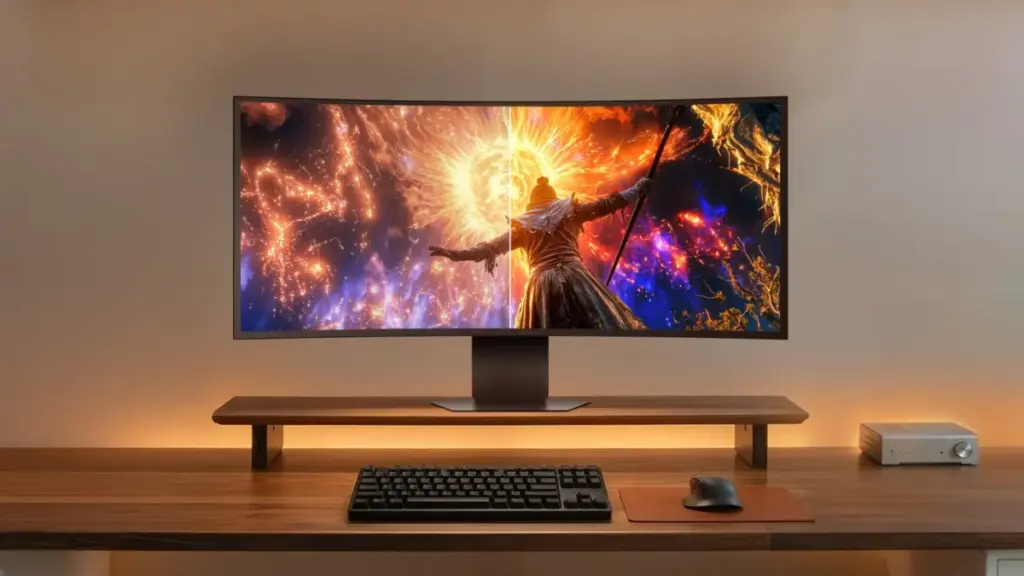
For players who have never experienced gaming on a large, curved ultrawide monitor, the shift can be genuinely transformative. An ultrawide display elevates immersion to an entirely new tier, as the digital game world effectively bleeds out into the user’s peripheral vision. It creates a convincing sense of place, whether a player is gripping the wheel of a hyper-tuned racing car, standing on the command bridge of a massive starship, or exploring ancient ruins. Beyond gaming, this expansive screen format offers immense productivity benefits, effectively functioning like two side-by-side desktop monitors housed within a single seamless chassis.
Historically, choosing an ultrawide monitor meant making immediate compromises regarding display resolution. However, the LG UltraGear evo GX9 refuses to cut corners, offering a native 5120 by 2160 resolution, often referred to as 5K2K, maintaining a crisp 143 pixels-per-inch density across its curved expanse.

The contrast ratio delivered by these OLED panels is nothing short of staggering at 1.85 million to one. Combined with a peak brightness of 1,500 nits and HDR True Black 500 certification, the GX9 leans heavily into the inherent strengths of OLED technology, including a near-instantaneous 0.03-millisecond grey-to-grey response time.
The visual separation between absolute black and brilliant light is so distinct that on-screen elements immediately pop out to the viewer. Visually demanding titles such as Cyberpunk 2077, Alan Wake, and Hellblade find an entirely new lease on life through this depth of contrast and color accuracy.
Much like its smaller stablemate in the GM9, the GX9 is fully equipped to keep pace with the industry’s most powerful desktop rigs. The monitor delivers a smooth 165Hz refresh rate at full 5K2K resolution, or a staggering 330Hz refresh rate at WFHD when utilizing Dual Mode. Meanwhile, visual artifacts such as screen tearing and stuttering are systematically eliminated by the variable refresh rate power of NVIDIA G-SYNC and AMD FreeSync Premium Pro integration.
Gaming Gets Good
In the broader context of the PC gaming industry, the ongoing challenge has always been closing the gap between the monumental processing power generated inside the computer tower and what the user’s eyes can actually perceive on the glass. With the introduction of these new LG UltraGear models, that persistent gap is closing rapidly.
The advanced specifications packed into both the GM9 and GX9 are not mere marketing window dressing. Instead, they operate in tandem to ensure that players can fully witness the complex graphical output generated by their PC hardware, enabling faster visual processing and quicker reactions in the heat of competition. For gamers, this convergence of technologies translates directly into heightened immersion, elevated performance, and ultimately, more victories.
Concurrently, professionals relying on these displays for daily productivity tasks stand to benefit from pristine text clarity, more realistic color reproduction, and deeper contrast ratios. These visual enhancements work to reduce long-term eye fatigue while improving overall operational precision across creative and technical workloads.